









Executive Overview
Meta CEO Mark Zuckerberg has spent the past several years laying the groundwork for what he envisions as the next monumental paradigm shift in human-computer interaction: the integration of pervasive, hyper-intelligent artificial intelligence into every facet of daily life. In a sprawling, 6,500-word manifesto published earlier this month, Zuckerberg articulated a future where every human being is accompanied by an always-on, highly capable personal AI agent. These agents, as he describes them, will act as cognitive extensions of ourselves—managing everything from our daily schedules and career trajectories to intimate health choices and complex financial portfolios.
Yet, as the rhetoric surrounding artificial intelligence reaches a fever pitch across Silicon Valley, a glaring disconnect has emerged between Meta’s utopian ambitions and the ground reality of public sentiment. To deliver on the promise of an AI "superintelligence agent," Meta will not merely require computational power; it will demand an unprecedented quantum of personal data. The system must know you, your habits, your vulnerabilities, your ambitions, and your intimate relationships to guide you effectively.
Herein lies the existential paradox for Meta: the company is attempting to sell a deeply intrusive, trust-dependent future to a public that fundamentally does not trust it.
Recent empirical data underscores the magnitude of this challenge. A landmark survey conducted by the University of Massachusetts Lowell’s Center for Public Opinion, in partnership with YouGov, reveals that Mark Zuckerberg is currently the least-liked public figure in the United States, facing deep-seated animosity across both ends of the political spectrum. Combined with compounding corporate crises—ranging from regulatory crackdowns on teenage social media addiction to public backlash against Meta’s camera-equipped smart glasses—Zuckerberg’s grand AI vision risks crashing against the formidable rocks of public skepticism, historical data abuses, and a severe corporate trust deficit.
Detailed Chronology: From the Metaverse to the AI Manifesto
To understand the current trajectory of Meta’s artificial intelligence strategy, it is necessary to examine the chronological evolution of the company’s pivot from the ill-fated "Metaverse" to generative and personal AI.
The Retreat from Spatial Computing
For years, Zuckerberg bet the proverbial farm on the Metaverse—a virtual reality-centric ecosystem that absorbed tens of billions of dollars through Meta’s Reality Labs division. However, consumer adoption failed to materialize at scale. Plagued by clunky hardware, nausea-inducing software experiences, and a general lack of practical utility for the average consumer, the Metaverse quickly became a financial black hole that spooked investors and invited relentless public mockery.
Recognizing the shifting technological winds—and heavily catalyzed by the explosive public debut of OpenAI’s ChatGPT in late 2022—Zuckerberg executed a sharp strategic pivot. Meta redirected its massive capital expenditure budgets, engineering talent, and computational clusters away from immersive virtual worlds and toward large language models (LLMs), generative AI tools, and consumer-facing AI assistants integrated directly into WhatsApp, Instagram, and Facebook.
The 6,500-Word AI Manifesto
The culmination of this pivot arrived earlier this month, when Mark Zuckerberg published a sweeping, 6,500-word manifesto detailing his philosophical and structural blueprint for an AI-driven society. In the document, Zuckerberg painted a portrait of a frictionless world enabled by proactive software agents.
"Everyone will have an exceptionally capable personal agent that understands you, your goals, and everything you care about," Zuckerberg wrote. "Your agent will work 24/7 on your behalf to improve your relationships, health, career, finances, home management, hobbies, and more. It will free up time for the things you enjoy, and help you accomplish more than you could otherwise."
For techno-optimists, this vision represents the ultimate democratization of executive-level assistance. Proponents argue that personalized AI could help individuals make smarter financial investments, adhere to preventive health regimens, navigate complex legal or bureaucratic landscapes, and eliminate the mundane administrative friction that clogs modern life.
However, the manifesto glossed over a critical, uncomfortable truth: the mechanics of such deep personalization require an invasive pipeline of data harvesting. An agent cannot optimize your health without access to your medical history, dietary habits, and biometric data. It cannot manage your finances without examining your bank accounts, spending habits, and credit scores. It cannot improve your relationships without parsing your private communications.
For a company whose historical business model is built entirely on surveillance capitalism—monetizing user data to sell targeted advertisements—asking the public to hand over the keys to their entire existence is a monumental, if not impossible, ask.
Supporting Context & Metrics: The UMass Lowell-YouGov Survey
The primary obstacle standing in the way of Zuckerberg’s utopian roadmap is not technological; it is sociological and psychological. The public simply does not trust Meta, nor do they hold favorable views of its chief executive.
A Bipartisan Consensus of Dislike
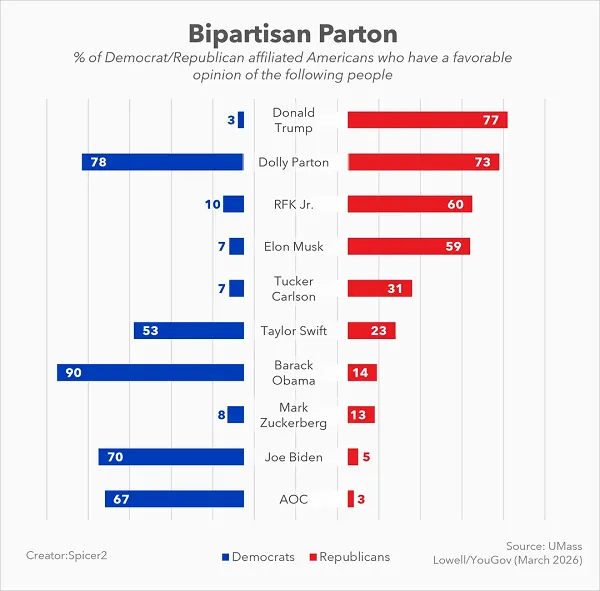
Data from the newly released UMass Lowell Center for Public Opinion survey, conducted alongside YouGov, provides a stark visualization of this sentiment. When evaluated across a spectrum of prominent public figures, Mark Zuckerberg landed at the absolute bottom of the favorability rankings.

What makes this finding particularly damning for Meta’s expansion plans is its bipartisan nature. In an era of hyper-polarized American politics, where agreement across party lines is virtually nonexistent, Republicans and Democrats have found rare common ground: an intense distrust and dislike of Mark Zuckerberg.
This cross-partisan antipathy was recently highlighted in data visualizations shared across online communities like Reddit’s r/DataisBeautiful. As internet users mapped out public sentiment in the wake of culturally beloved figures—such as the universally adored singer Dolly Parton—the contrast with Zuckerberg’s metrics could not have been starker. While figures like Parton enjoy soaring net-positive favorability ratings driven by decades of perceived authenticity and goodwill, Zuckerberg’s metrics reflect a persistent deficit of public affection.
The Cumulative Weight of Historical Scandals
This pervasive distrust did not materialize overnight. It is the cumulative product of over a decade of high-profile corporate missteps, privacy breaches, and ethical controversies. From the Cambridge Analytica scandal—which exposed how millions of user profiles were harvested without explicit consent for political targeting—to internal whistleblower disclosures revealing that Meta executives were well aware of the toxic mental health impacts Instagram inflicted on teenage girls, the company’s brand has been systematically eroded.
Every time Meta attempts to rebrand—shifting from Facebook to Meta, or pivoting from social media to the Metaverse, and now from the Metaverse to artificial intelligence—it carries the historical baggage of its past actions. Consumers are increasingly wise to the reality that when a digital product is "free," they are the product. Extending that dynamic from targeted ads to personal life management bridges a chasm of privacy that many users are entirely unwilling to cross.
Official Statements and Corporate Damage Control
Meta is not blind to its trust deficit. Over the past year, the company has engaged in a multi-pronged public relations and regulatory strategy aimed at mitigating damage, rehabilitating its image, and signaling compliance with societal norms.
The Teenage Social Media Settlement
In an effort to appease regulators, child advocacy groups, and anxious parents, Meta recently entered into a massive, highly publicized legal and operational settlement designed to restrict teenage social media usage. The agreement introduces stricter content guardrails, enhanced parental controls, and algorithmic adjustments intended to curb compulsive platform scrolling among minors.
While legal analysts view the settlement as a necessary step toward defusing mounting courtroom liabilities—where dozens of state attorneys general have sued social media companies over youth mental health crises—critics argue it is a reactive measure rather than a proactive moral awakening. The damage to Meta’s reputation as a safe steward of youth digital spaces has already been deeply entrenched.
The "Perve Glasses" Controversy
Compounding these trust issues on the hardware front is the rocky rollout of Meta’s latest consumer electronics product: AI-powered, camera-equipped smart glasses, developed in partnership with Ray-Ban.
Marketed as a seamless way to capture memories, ask real-time questions about your environment, and interact with Meta’s voice assistant, the glasses have quickly sparked intense social backlash. Due to the discreet placement of the cameras and the ease with which wearers can record video without making it obvious to those around them, the device has earned a deeply unflattering moniker in the public lexicon: "perve glasses."
The backlash highlights a recurring theme in Meta’s product design philosophy: innovation is prioritized ahead of societal consent and privacy boundaries. When consumers see a tech giant pushing products that enable covert recording in public spaces, it directly undermines the narrative that Meta’s upcoming AI agents will respect personal boundaries and prioritize user well-being.
Future Outlook: Can Meta Overcome the Trust Deficit?
As Meta charges headfirst into the artificial intelligence era, the company faces a moment of existential reckoning. Zuckerberg’s vision of a personal AI superintelligence agent is technologically intoxicating, but its commercial viability hinges entirely on consumer willingness to grant sweeping, intimate access to their lives.
To turn the tide, Meta must achieve what it has thus far failed to do: convince the global public that its primary motivation is human empowerment rather than data extraction and profit maximization.
Key Variables for Meta’s AI Future:
- Ironclad Privacy Architecture: If Meta hopes to convince users to trust personal AI agents with financial, medical, and relational data, it must implement radical, uncompromised privacy frameworks—such as local on-device processing where data never touches Meta’s centralized servers. Historically, however, Meta’s entire business model relies on cloud-based data aggregation. Resolving this contradiction will require an unprecedented restructuring of their economic incentives.
- Regulatory Headwinds: As governments worldwide tighten the screws on artificial intelligence governance, data privacy (such as the European Union’s GDPR and upcoming AI Acts), and algorithmic transparency, Meta will face severe legal constraints regarding how it trains and deploys its models.
- Leadership Perception: Mark Zuckerberg remains the ultimate lightning rod for criticism. Unless Meta can effectively de-center its controversial CEO from the day-to-day branding of its consumer-facing AI tools, the deep-seated public animosity documented in the UMass Lowell-YouGov survey will continue to act as a glass ceiling for adoption.
Ultimately, artificial intelligence represents the most powerful technological frontier humanity has ever approached. For Mark Zuckerberg, the dream of a personal AI companion guiding humanity toward self-actualization is within technological reach. Whether the public will allow him to be the one holding the leash, however, remains one of the defining corporate and cultural questions of our time.