







Executive Overview
While the commercial viability of battery-swapping infrastructure has faced persistent hurdles and high-profile failures across North America, Europe, and parts of East Asia, a different economic reality is unfolding on the subcontinent. In India, a massive urban delivery ecosystem, millions of active daily gig-economy workers, and a ubiquitous fleet of electric two- and three-wheelers have combined to create fertile ground for high-frequency energy replenishment models.
Capitalizing on this distinct market dynamic, Canadian auto parts and mobility titan Magna International is deepening its footprint in the region. Magna has announced a fresh $35 million investment into Yuma Energy, a Bengaluru-headquartered AI-powered battery-swapping network. This capital infusion increases Magna’s majority stake beyond the 51% it secured when the joint venture was originally formed in early 2023. Consequently, the ownership stake of Yuma’s parent mobility startup, Yulu, will be diluted from its previous 49% holding, though exact post-transaction equity splits remain confidential.
This strategic injection underscores a broader conviction: that India’s rapidly scaling quick-commerce and delivery sectors represent the ultimate proving ground for micromobility electrification. For Yuma, the capital will act as a primary engine to scale its infrastructure, double its active battery fleet to approximately 200,000 units, and target EBITDA break-even within the next two quarters. As global automotive suppliers search for high-growth pathways out of legacy combustion manufacturing, Magna’s aggressive bet on Yuma serves as a defining case study in localized, high-density electric vehicle (EV) infrastructure financing.
Detailed Chronology: From Joint Venture to Strategic Scaling
The evolution of Yuma Energy from an internal mobility concept to an independent infrastructure heavyweight reflects a carefully choreographed series of strategic maneuvers between Canadian engineering capital and Indian urban mobility execution.
The Genesis: 2022–2023
The partnership’s roots trace back to September 2022, when Magna International made a splash in the Indian micromobility sector by committing a combined $77 million across two entities: $25 million directly allocated to the urban EV rental and fleet operator Yulu, and $52 million dedicated to establishing an independent battery-swapping joint venture.
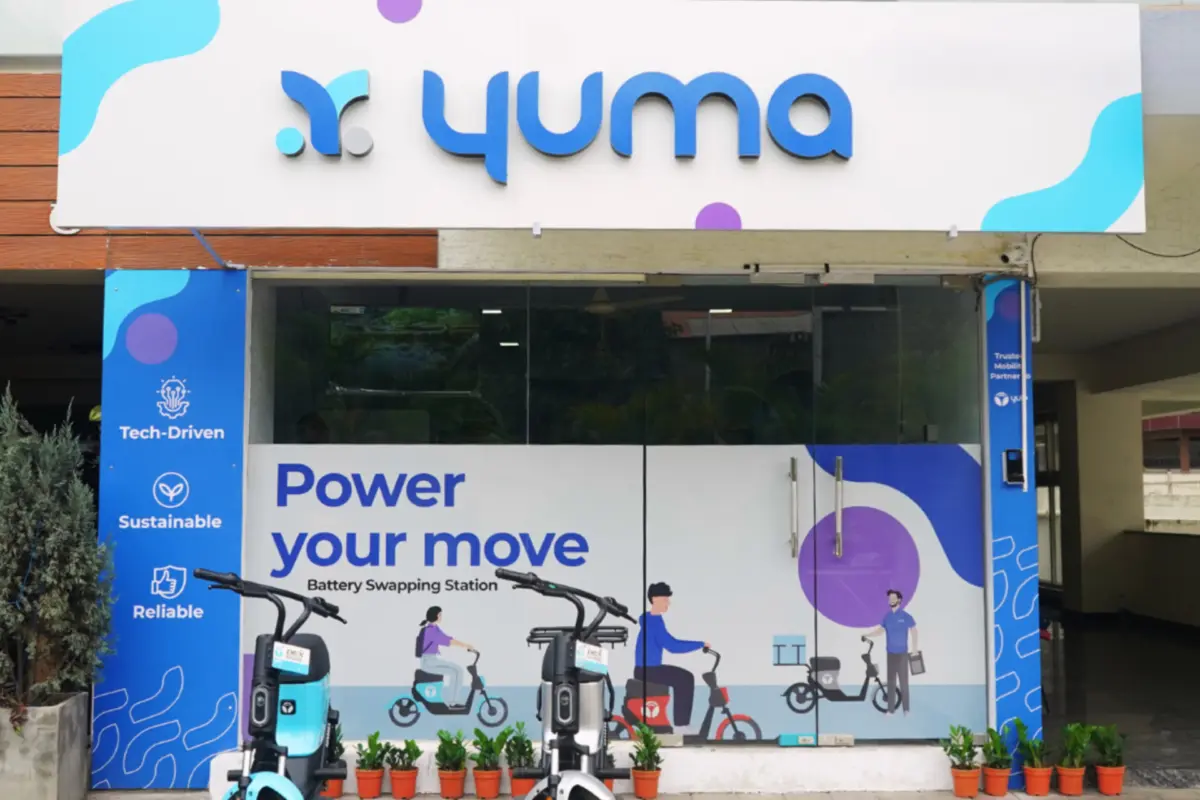
By early 2023, that joint venture officially materialized as Yuma Energy. Designed as an open-network, AI-powered energy-as-a-service platform, Yuma was tasked with solving the charging bottleneck for Yulu’s sprawling fleet of low-speed electric two-wheelers, while simultaneously building the infrastructure required to service the broader third-party EV market.
Rapid Scale and Operational Milestones
Over the subsequent three years, Yuma scaled at an aggressive clip, moving far beyond a captive service provider for its parent company. By mid-2026, the company achieved several critical operational benchmarks:
- Milestone Volume: Surpassed 60 million cumulative lifetime battery swaps.
- Fleet Deployment: Reached approximately 100,000 active batteries deployed across its network.
- Geographic Footprint: Expanded operations to 18 major Indian cities, including tier-1 and tier-2 hubs such as Bengaluru, Hyderabad, Mumbai, the Delhi National Capital Region (NCR), Jaipur, Lucknow, Indore, Coimbatore, Kochi, and Kolkata.
- Financial Performance: Closed the financial year in March 2026 with an annualized revenue run rate of roughly ₹1 billion (approx. $10.5 million USD).
The $35 Million Capital Injection (2026)
In the latest chapter of this corporate timeline, Magna’s $35 million investment elevates its financial commitment well past its initial 2022 outlays. According to Yuma’s Managing Director, Muthu Subramanian, this capital will be aggressively deployed over the next 12 to 18 months to fund dense infill network expansion in existing cities—such as adding stations across current markets—while launching operations in new metropolitan regions, notably Chennai and Pune.
Simultaneously, Yulu—Yuma’s sibling and primary foundational customer—closed a massive $93 million equity financing round in August 2026 to scale its own electric two-wheeler fleet. Because Yulu’s aggressive growth directly translates to surging energy demand, Yuma’s accelerated infrastructure rollout is not merely an independent expansion play; it is an operational necessity to prevent gridlock within its primary customer’s ecosystem.
Supporting Context & Metrics: Decoding India’s Micro-Mobility Economics
To understand why Magna is doubling down on a capital-intensive charging infrastructure play in India—a category that has notoriously bled cash in Western markets—one must examine the unique macroeconomic forces governing the country’s gig economy and urban transit networks.
The Gig Economy Catalyst
India’s hyper-growth quick-commerce, food delivery, and ride-hailing sectors rely heavily on millions of gig-economy workers who traverse dense urban corridors daily. For these riders, time is literally currency. Traditional internal combustion engine (ICE) scooters expose workers to volatile fossil fuel pricing, while conventional plug-in EV charging presents a devastating operational bottleneck: downtime.
According to industry data highlighted by Redseer Strategy Consultants, the Indian gig economy is tracking exponential growth through the latter half of the decade. Yet, despite the obvious cost-of-ownership benefits of electric mobility for high-mileage drivers, Subramanian estimates that only 10% to 15% of vehicles currently utilized by gig workers in India are electric.
This stark under-penetration represents a massive total addressable market (TAM). High daily runtimes mean that the Total Cost of Ownership (TCO) heavily favors EVs—provided that vehicles maintain near-continuous uptime.
Swapping vs. Fast Charging: The Two-Minute Advantage
The technical thesis underpinning Yuma’s business model rests on a fundamental time-to-value proposition:
- Standard Plug-In Charging: Requires stationary access, significant parking real estate, and robust grid transformers capable of supporting simultaneous high-power draws. Furthermore, a 20-to-30-minute fast charge forces a delivery driver off the road during peak operational hours, directly depressing daily earnings.
- Battery Swapping (The Yuma Model): Enables a rider to pull into a station, extract a depleted battery, insert a fully charged unit, and resume transit in under two minutes.
"With Indian gig workers’ high runtime on a daily basis, an EV makes absolute sense in terms of cost of ownership," Subramanian noted in an interview with tech publications. "Uptime is important."
Capital Intensity and Unit Economics
Building this frictionless convenience, however, carries a heavy financial burden. Yuma is operating in a classic chicken-and-egg infrastructure dilemma: the firm must manufacture, deploy, and maintain batteries and swapping cabinets ahead of actual rider demand to ensure spatial ubiquity.
"It’s a capital-intensive business, and the unit economics will play out at scale," Subramanian acknowledged.
While Yuma is not yet profitable on a consolidated corporate level, the financial trajectory is stabilizing. Several of the company’s older, high-utilization swapping stations have already crossed into EBITDA-positive territory. Backed by the new $35 million infusion, management has charted a clear runway toward achieving overall EBITDA break-even within the next two quarters.
Official Statements and Industry Perspectives
The strategic alignment between Magna and Yuma highlights a unique manufacturing integration strategy that separates Yuma from software-only or asset-light aggregator networks.
Hardware Control and Vertical Integration
Unlike many third-party network operators that source off-the-shelf components from fragmented suppliers, Yuma maintains tight vertical control over its physical ecosystem. The enterprise designs and manufactures its own battery packs and charging cabinets.
- Battery Production: Battery packs are fabricated at Yuma’s dedicated facility in Chennai.
- Charging Units: Power management hardware and swapping stations are engineered and built in Bengaluru.
This vertical integration grants Yuma end-to-end control over thermal management, safety protocols, and firmware updates—critical components when managing hundreds of thousands of high-output lithium-ion cells deployed in punishing tropical climates and subjected to heavy industrial use by delivery fleets.
Diversification Beyond Yulu
Historically, Yuma’s operational lifeblood has been Yulu. The vast majority of the network’s 60 million lifetime swaps originated from Yulu’s iconic blue electric two-wheelers. However, a deliberate diversification strategy is bearing fruit.
During the most recent operational quarter, 15% to 20% of all swaps originated from non-Yulu customers. Yuma currently services over five distinct commercial fleets and has successfully integrated its proprietary battery architecture with more than 10 different vehicle platforms. This multi-OEM compatibility roster includes major Indian EV manufacturers such as:
- Kinetic Green
- Motovolt
- BGauss
- Quantum Energy
Management projects that non-Yulu multi-brand customers will account for 25% of total network swaps within the next two years, signaling Yuma’s successful transition from an exclusive internal corporate spin-out to an open-market energy utility.
Future Outlook: Beyond India’s Borders
While Yuma’s immediate operational roadmap remains firmly anchored to the Indian domestic market over the next 12 to 18 months, the long-term horizons extend far beyond South Asia.
Scaling the Domestic Footprint
In the near term, the $35 million capital injection will directly fund:
- Fleet Expansion: Doubling the current pool of 100,000 batteries to roughly 200,000 units.
- Geographic Infill: Launching network operations in Chennai and Pune while densifying infrastructure in the 18 cities where Yuma is already active.
- Capacity Building: Expanding manufacturing output at the Chennai and Bengaluru facilities to support the rapid scaling of multi-OEM integrations.
International Expansion Horizons
Looking further ahead, Magna and Yuma’s leadership view the Indian battery-swapping blueprint as a highly exportable model. Developing economies characterized by congested urban cores, high ambient temperatures, and massive two- and three-wheeler micro-mobility ecosystems present identical macroeconomic fundamentals.
Subramanian highlighted Southeast Asian markets—specifically Vietnam and Thailand—alongside select African economies as prime long-term candidates for international expansion. These regions feature gargantuan combustion-engine two-wheeler populations ripe for electrification, where traditional charging infrastructure is similarly constrained by grid stability and real estate scarcity. While formal cross-border expansion discussions have not yet commenced, the foundational architecture being tested and perfected across India’s grueling megacities is purpose-built for eventual global deployment.
Conclusion
Magna International’s decision to up its stake in Yuma Energy with a $35 million investment serves as a definitive vote of confidence in India’s unique EV ecosystem. While Western markets have largely cooled on standalone battery-swapping ventures due to prohibitive capital expenditures and the rise of fast-charging corridors, India’s explosive quick-commerce boom and extreme gig-economy runtimes demand a radically different infrastructural response.
By maintaining strict vertical integration over its hardware manufacturing, aggressively expanding its multi-OEM vehicle compatibility, and scaling to support parent company Yulu’s $93 million war chest, Yuma is positioning itself not just as an Indian infrastructure play, but as a blueprint for global micromobility energy delivery. As the company marches toward EBITDA break-even and targets a doubled battery fleet over the next year and a half, the experiment in high-density, two-minute energy swaps is well on its way to proving its ultimate economic viability at scale.