







Executive Overview
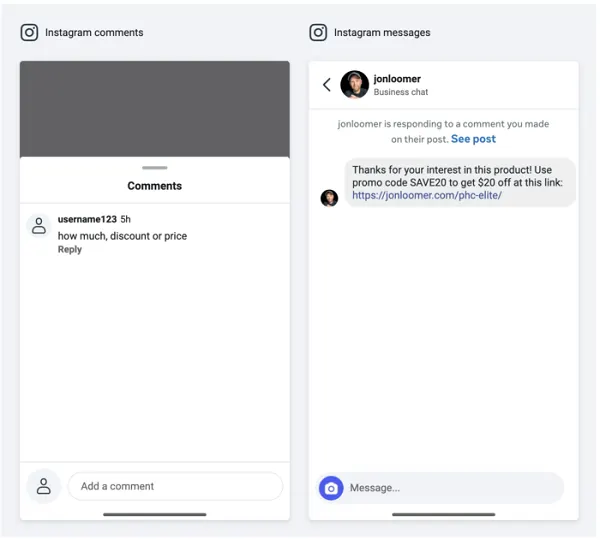
In an aggressive move to bridge the gap between public social media engagement and private consumer conversion, Meta is currently rolling out a powerful new advertising feature: Reply to Keywords. Initially spotted and brought to light by prominent digital marketing and Meta ads expert Jon Loomer, this innovative tool is designed to auto-generate direct messages (DMs) to users who drop specific keywords into the comment section of sponsored Instagram posts.
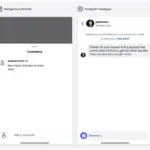
By streamlining the path from passive ad viewer to active lead, Meta is tackling one of the most persistent bottlenecks in social media marketing: friction in the follow-up process. Under the traditional framework, brands running engagement campaigns on Instagram often rely on manual responses or complex third-party tools to sift through comment sections, identify interested prospects, and manually initiate private conversations. Reply to Keywords automates this entire sequence. Advertisers can select up to five distinct keywords per ad set, instantly triggering a personalized, automated DM whenever a user inputs one of those target words into a comment.
While foundational elements of this keyword-triggered functionality have previously existed within Meta’s broader suite of inbox automation tools and the Meta Business Agent, this latest iteration represents a crucial evolution. By embedding the feature directly into the Instagram ad setup workflow, Meta is lowering the barrier to entry for conversational commerce.
This strategic rollout aligns with a broader industry shift. Over the past few years, social media interactions have fundamentally migrated away from public feeds and into private messaging channels. Consumers increasingly prefer the intimacy and convenience of DMs for customer service, inquiries, and transactions. By capitalizing on this trend, Meta’s new feature gives brands a streamlined, native mechanism to capture high-intent leads without requiring cumbersome external software integrations.
However, questions remain regarding how this feature will scale, how consumers will react to automated outreach triggered by public comments, and whether the tool’s simplicity will prove to be its greatest strength or its primary limitation in an era dominated by generative artificial intelligence.
Detailed Chronology of the Feature’s Rollout
The emergence of the Reply to Keywords ad option did not happen overnight; it is the latest chapter in Meta’s multi-year crusade to make direct messaging the central hub of digital commerce and social communication.
Phase 1: The Rise of Inbox Automation and Meta Business Agents
Long before the Reply to Keywords ad integration appeared, Meta recognized that organic and paid reach required better conversion pathways. The company gradually introduced inbox automation capabilities, allowing page administrators and business account managers to set up rudimentary rule-based responses for incoming messages. These tools eventually evolved into more sophisticated assets like the Meta Business Agent, which aimed to handle basic customer inquiries, FAQ routing, and lead qualification within Messenger and Instagram Direct.
However, these early iterations were largely reactive. They required users to take the initiative by opening a chat window or responding to a broadcast. Brands still had to orchestrate creative ways to drive users from a public ad or post into the private inbox—often relying on manual calls-to-action like "Send us a DM for the link."
Phase 2: The Shift Toward Comment-to-DM Workflows
Recognizing the friction inherent in forcing users to switch contexts from the feed to the inbox, third-party marketing tools (such as ManyChat) exploded in popularity. These platforms pioneered the "comment-to-DM" tactic, where brands would encourage users to comment a specific word (e.g., "GUIDE" or "DISCOUNT") to automatically receive a private message containing a resource or offer.
The strategy proved wildly successful. Marketers discovered that public comments not only boosted algorithmic distribution through engagement signals, but also created an immediate, high-intent audience pool for direct outreach. Recognizing the massive demand for this workflow, Meta began developing a native, frictionless solution built directly into its advertising infrastructure.
Phase 3: The Discovery and Limited Beta Rollout
The existence of the native Reply to Keywords feature came to light when digital marketing experts, spearheaded by Jon Loomer, noticed new setup modules appearing within the Meta Ads Manager for select advertisers.
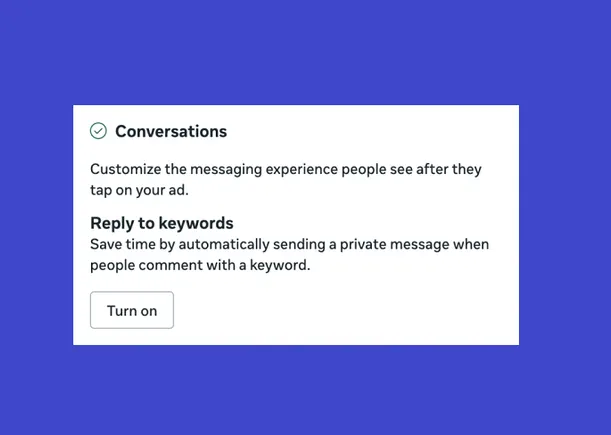
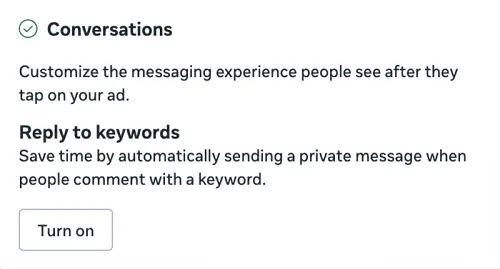
At this current stage of the rollout, the feature is experiencing a phased, limited release. Crucially, the capability is presently confined strictly to Instagram ad set-up tools, with no visible integration for Facebook ads as of yet. Early adopters navigating the updated ad creation interface have reported seeing dedicated prompt cards explaining the feature’s core value proposition: saving time and maximizing lead capture by instantly transitioning users from public engagement to private conversations.

Supporting Context & Metrics: The Migration to DMs
To fully understand the strategic importance of Meta’s Reply to Keywords tool, one must examine the macro-level shifts in consumer behavior that have forced platforms to reinvent how brands and buyers interact.
The Death of the Public Feed and the Rise of Dark Social
For over a decade, digital marketing was dominated by public metrics: likes, shares, and public comments on brand posts. However, consumer habits have undergone a tectonic shift. Users are increasingly sharing content, debating products, and engaging with brands via "dark social"—private channels, encrypted chats, and direct messages.
Industry data underscores this reality. According to various digital marketing studies and Meta’s own internal insights, billions of connections are forged daily through messaging apps. Consumers view DMs as a low-pressure, high-trust environment. They can ask sensitive questions, negotiate pricing, or finalize purchases without broadcasting their consumer behavior to their entire social graph.
Why Comment Prompts Drive Conversion
The psychology behind the Reply to Keywords feature relies on micro-commitments. In behavioral economics, getting a user to take a small, frictionless action—such as typing a single word like "WINNING," "INFO," or "SHOP"—drastically increases the probability that they will complete a subsequent, higher-value action.
When an Instagram user comments on a promoted post, they cross a psychological threshold from passive scroller to active participant. By instantly rewarding that public comment with a tailored private message, brands capitalize on instantaneous gratification.
- Reduced Latency: In digital marketing, speed-to-lead is everything. Studies consistently show that the likelihood of qualifying a lead drops exponentially with every minute of delay. Automating the initial DM response ensures a response time of zero seconds.
- Algorithmic Synergy: Instagram’s recommendation algorithm heavily weights comments as a primary indicator of content quality. By prompting users to comment a keyword, advertisers artificially stimulate comment volume, which in turn expands the organic and paid reach of the advertisement.
- Clutter Reduction: Instead of forcing customer service teams to manually reply to hundreds or thousands of comments with repetitive links or instructions ("Check your DMs!"), the system handles the heavy lifting autonomously.
Official Insights and Platform Mechanics
An examination of the backend interface reveals how advertisers are intended to wield this new capability within the Meta Ads ecosystem.
Setup and Configuration
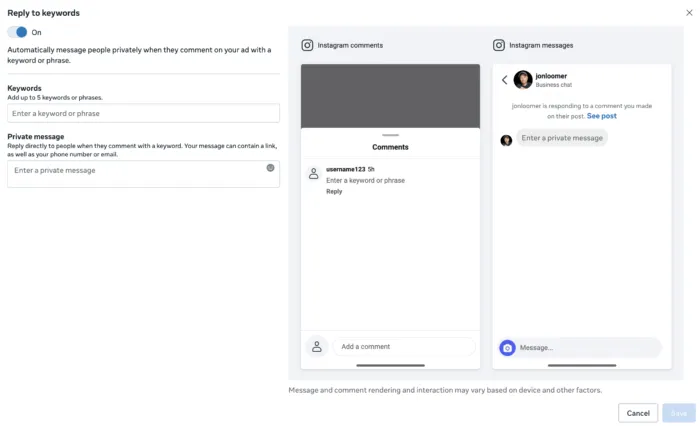
When setting up an Instagram ad eligible for the feature, marketers encounter a dedicated setup module. The mechanics are intentionally designed for simplicity:
- Keyword Selection: Advertisers are permitted to input up to five unique keywords per ad configuration. These can be specific terms relevant to the campaign, such as product names, promotional codes, or call-to-action triggers (e.g., “DEAL,” “CATALOG,” “SAMPLE”).
- Trigger Parameters: The system continuously monitors the comments section of the promoted post. The moment a user’s comment contains an exact match or closely associated variant of one of the designated keywords, the automation engine is triggered.
- Automated Message Crafting: Advertisers draft the automated response that will be dispatched directly to the commenter’s Instagram inbox. This message can include text, links to landing pages, lead capture forms, or specific product catalogs.
[User Sees Instagram Ad]
       │
       ▼
[User Comments Keyword ("INFO")]
       │
       ▼
[Meta Ads Engine Detects Keyword]
       │
       ▼
[Automated DM Sent Instantly with Link/Offer]
Strategic Use Cases for Marketers
Early marketing analyses suggest several high-impact ways brands plan to leverage Reply to Keywords:
- Lead Magnet Delivery: Brands offering free whitepapers, guides, or discount codes can use prompts like, "Comment ‘GUIDE’ below, and we’ll slide the PDF right into your DMs."
- E-Commerce Upselling: Fashion and retail brands can showcase a new collection reel and prompt viewers to comment a style name to receive direct purchase links.
- Event Registration: Webinar hosts and virtual event organizers can capture registrations seamlessly by asking users to comment a registration keyword.
Despite these advantages, industry observers have noted a philosophical paradox within the current implementation. In an era dominated by advanced generative artificial intelligence—where conversational agents can engage in nuanced, multi-turn dialogues—Meta’s keyword-triggered DM is remarkably simple. It relies on rigid, binary triggers rather than context-aware natural language processing.
However, marketing veterans argue that this simplicity is precisely where its value lies. Complex AI agents can sometimes introduce friction or unexpected errors if a user strays from expected phrasing. A hardcoded keyword trigger offers predictable, reliable execution with zero margin for algorithmic misunderstanding.
Future Outlook: What Lies Ahead for Conversational Ads
As Meta continues to test and refine the Reply to Keywords feature, several vital questions remain regarding its evolution and long-term impact on the digital advertising landscape.
1. Expansion Beyond Instagram
Currently, the feature is isolated within Instagram ad setups. Given Meta’s historical trajectory of cross-platform feature parity, it is highly anticipated that the tool will eventually roll out to Facebook ads, Messenger placements, and potentially WhatsApp business integrations. Unifying keyword-to-DM triggers across Meta’s entire family of apps would provide brands with an omnichannel direct-response powerhouse.
2. Integration with Generative AI
While the current version of the tool relies on static, pre-written auto-DMs, the natural evolution of this technology points toward deep AI integration. Imagine a scenario where a keyword comment doesn’t just trigger a static link, but initiates an intelligent conversational agent capable of answering product questions, checking inventory, and processing checkouts entirely within Instagram Direct. Meta’s ongoing investments in Llama models and business-facing AI agents make this a logical next step.
3. User Fatigue and Platform Guardrails
As with any new advertising tactic, marketers must remain vigilant regarding consumer fatigue. If every brand on Instagram begins utilizing identical "Comment X for Y" prompts, users may develop banner blindness or irritation toward overly automated comment sections. Furthermore, Meta will need to enforce strict anti-spam guidelines to ensure that bad actors do not abuse the feature to flood user inboxes with unsolicited promotional material.
Conclusion
Meta’s Reply to Keywords ad option represents a pragmatic, highly requested evolution in social media advertising. By bridging the gap between public engagement and private conversion, it offers brands a frictionless way to nurture leads and capitalize on the modern consumer’s preference for direct messaging. While deceptively simple in its current iteration, this tool lays the foundational groundwork for the future of conversational commerce—proving that sometimes, the shortest distance between a brand and a customer is a single well-chosen word.