








SHANGHAI — “Look, it is trying to do a handstand!”
An 11-year-old boy shouts these words with uncontainable excitement, watching his newly acquired mini robotic dog execute a series of awkward, mechanical tumbles. The toy pet was just purchased by his mother at a bustling robot “carnival” hosted by a massive research and development hub on the outskirts of Shanghai. On this public holiday, the sprawling facility is flooded with curious families eager to witness firsthand how the future of artificial intelligence looks, sounds, and moves.
Across China, humanoid and specialized robots are no longer confined to sterile industrial assembly lines, university laboratories, or heavily guarded tech conferences. Instead, they are stepping directly into the public sphere. From shopping malls and tourist attractions to public squares and weekend festivals, intelligent machines are becoming a prominent, highly visible form of public entertainment.
This transformation is not happening by accident. It is the direct result of a calculated national strategy to integrate artificial intelligence deeply into physical systems—a concept known globally as “embodied AI.” By marrying advanced algorithmic learning with physical hardware, China is aggressively positioning itself at the vanguard of the next industrial revolution, transforming futuristic science fiction into everyday reality.
Executive Overview: China’s Strategic Leap into Embodied AI
The widespread public exhibition of robotics in cities like Shanghai represents the tip of a much larger, highly coordinated national initiative. Embedding artificial intelligence into physical systems was established as a core strategic pillar in China’s latest five-year economic plan, signaling a top-down governmental commitment to dominate the robotics sector.
The economic and manufacturing weight behind this initiative is staggering. According to global shipment tracking data, nearly 90% of the more than 13,000 two-armed, two-legged humanoid robots delivered worldwide last year were manufactured in China. While Western tech firms frequently grapple with high research and development costs, stringent safety hurdles, and corporate skepticism regarding the utility of bipedal designs, Chinese manufacturers are scaling production at an unprecedented pace.
By bringing these machines out of the laboratory and into community spaces like the Intelligent Manufacturing & Robotics Global Co-Innovation Center in Shanghai, industry leaders and policymakers are running a massive, nationwide public relations and consumer-testing campaign. The goal is twofold: demystify complex robotics for the average citizen and rapidly gather real-world behavioral data to refine machine learning models.
On this particular holiday weekend in Shanghai, the campaign appears to be working. The skepticism that often clouds discussions of humanoid utility in Western markets is entirely absent here, replaced instead by wonder, consumer enthusiasm, and chants for “more.”

Detailed Chronology: A Day Inside the Shanghai R&D Hub
The Intelligent Manufacturing & Robotics Global Co-Innovation Center is normally a temple of serious engineering. Housing more than 100 specialized enterprises dedicated to researching, developing, manufacturing, and marketing robotic hardware, the hub is typically a hive of industrial innovation. Here, engineers design bots capable of inspecting deep, hazardous sewage pipes, navigating treacherous terrain, and lifting heavy industrial loads that would otherwise endanger human workers.
On this holiday, however, the heavy machinery has been repurposed for public delight.
Morning: Hands-On Encounters and Robotic Battles
As morning turns to afternoon, families stream through the gates, navigating a maze of exhibits that blur the line between utility and entertainment.
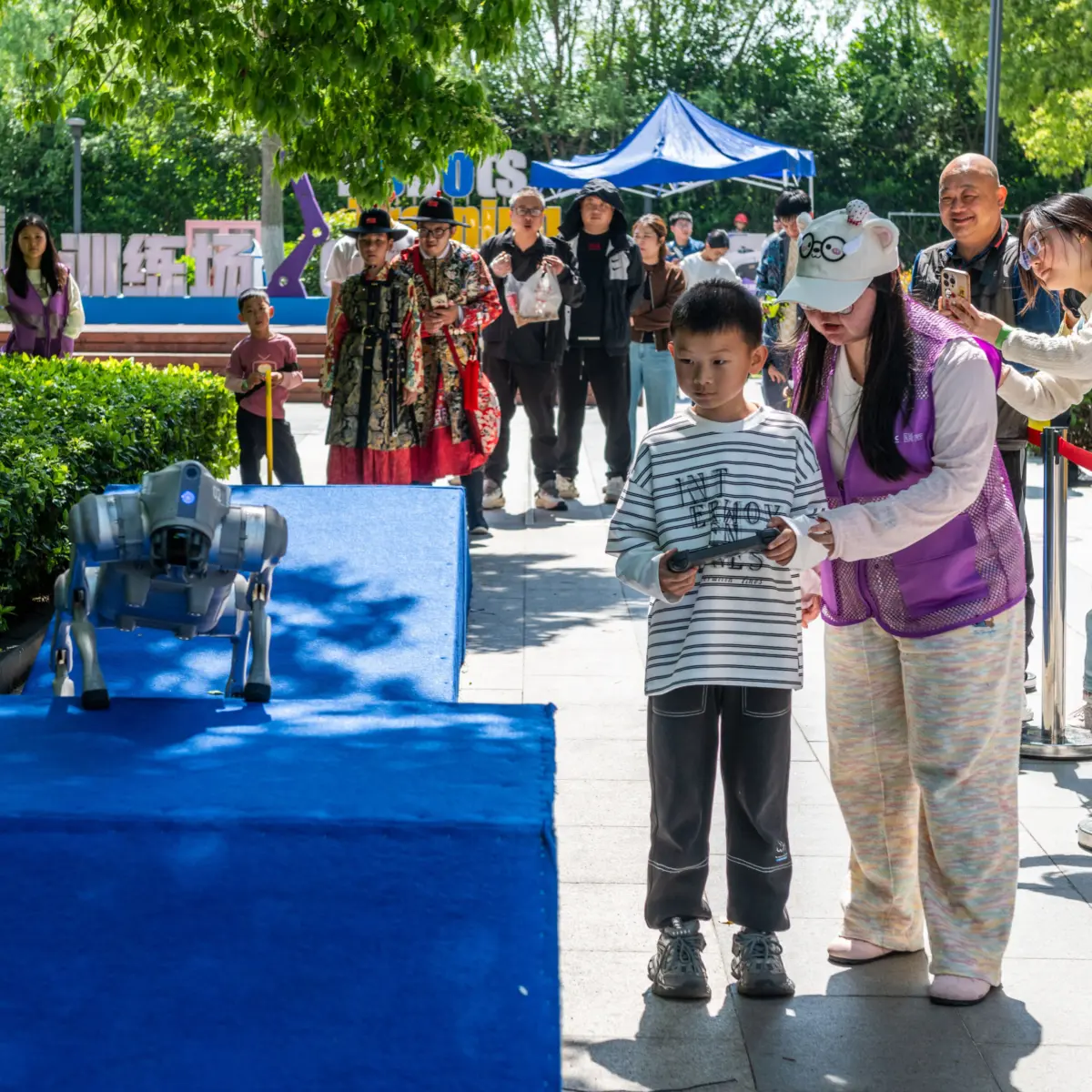
Meters away from the tent where children queue up to purchase robotic pets, a pair of patient technicians guides youngsters through an interactive exercise: teaching a four-legged quadrupedal robot how to steadily climb a flight of stairs. The children handle the remote interfaces with intuitive ease, treating the advanced hardware as naturally as a smartphone.
Deeper into the compound, the atmosphere shifts from educational to competitive. A tense crowd gathers around a temporary netted ring, cheering wildly as two remote-controlled robots engage in a high-stakes duel, firing harmless plastic water beads at one another. After a fiercely fought exchange of tactical maneuvers and defensive dodging, a staff official steps forward to declare the match an honorable draw, drawing groans and laughter from the youthful spectators.
Afternoon: Practical Utility Meets Performance Art
While the toy displays and combat rings capture the children’s imaginations, adult attendees are drawn toward booths demonstrating practical automation.
Yang Duan, a product manager at DexForce—a prominent firm exhibiting at the carnival—explains the broader philosophical mission driving these exhibits. “These machines can free people from physical work and mundane chores,” Yang notes, gesturing toward an autonomous robotic model calmly operating a commercial espresso machine, grinding beans and pouring milk with precise dexterity.
A few booths down, a dual-armed robotic system outfitted with advanced computer vision attempts to fold a massive basket of freshly laundered T-shirts. The movements are remarkably fluid, though occasional hesitation reveals the ongoing computational challenges of manipulating soft, pliable textiles.

As the afternoon peaks, the crowds migrate toward the festival’s expansive main tent, drawn by the sound of rhythmic percussion and roaring applause. Inside, the spectacle reaches its theatrical zenith. A humanoid robot adorned in a gleaming, jewel-encrusted top is executing the intricate, swaying footwork of traditional Chinese drunken boxing. Moments later, a companion bipedal model launches into a clean, gravity-defying front flip, eliciting gasps from the packed bleachers.
Along the perimeter of the stage, a squad of small, robotic lions synchronizes their mechanical joints, waiting patiently for their turn to perform the traditional lion dance. The audience, utterly captivated, begins to chant in unison:
“More, more, more!”
Supporting Context & Metrics: The Global Robotics Landscape
To fully understand the significance of Shanghai’s robot carnival, one must examine the broader global context of humanoid and embodied AI development. For years, the international robotics community has been sharply divided over the viability of humanoids.
The Engineering and Economic Hurdles
In Western markets, progress in humanoid robotics has often been painstakingly slow. Critics and cautious engineers frequently highlight several major roadblocks:
- The Balancing Act: Bipedal locomotion requires immense computational power and complex feedback loops to maintain balance, making humanoids inherently prone to falls and mechanical stress.
- Mass and Safety: Because humanoids are heavy and driven by powerful actuators, deploying them safely around untrained humans presents significant liability and safety challenges.
- Power Constraints: High energy consumption coupled with notoriously short battery lives severely limits the operational window of most humanoid models.
- Form-Factor Skepticism: Many roboticists argue that mimicking the human body is an inefficient design choice, noting that wheeled or tracked drones are far superior for logistics, while specialized robotic arms are better suited for factory floors.
China’s Counter-Strategy: Scale, Speed, and Social Integration
Chinese firms have chosen to bypass these philosophical debates by adopting an aggressive, iterative approach to hardware development and public deployment. Rather than waiting for perfection behind closed doors, companies are pushing prototypes directly into the real world.
The strategy extends far beyond Shanghai. Shopping malls, high-traffic tourist destinations, and municipal parks in several major Chinese cities now regularly feature humanoid robots performing administrative tasks, greeting visitors, or executing choreographed entertainment routines. In Beijing, bipedal robots have even been deployed to run alongside human participants in half-marathons, testing their endurance, heat management, and long-range battery efficiency under grueling physical conditions.
This high-visibility public relations campaign is fundamentally shifting cultural perceptions. By integrating robots into the cultural fabric of daily life—pairing advanced technology with traditional arts like drunken boxing and lion dances—Chinese developers are successfully transforming cold, intimidating industrial machines into beloved community characters.

Official Statements and Industry Perspectives
The rapid commercialization and public acceptance of robots in China underscore a fundamental shift in how artificial intelligence companies view consumer relations.
Industry leaders emphasize that public exposure is a crucial component of the development lifecycle. Without direct human interaction, engineers miss vital feedback regarding how people naturally react to, communicate with, and trust autonomous machines in shared physical spaces.
"Our primary objective is to bridge the gap between advanced R&D and human comfort," says an engineering lead affiliated with the Shanghai co-innovation hub. "When a child laughs at a robotic dog doing a handstand, or an adult watches a humanoid fold laundry without fear, we aren’t just selling a product—we are building a cultural license for automation to enter society."
Product managers like DexForce’s Yang Duan reiterate that the ultimate promise of embodied AI lies in its capacity to alleviate the burdens of modern labor. As aging populations place unprecedented demographic pressure on workforces across East Asia, autonomous machines capable of handling mundane, repetitive, and physically taxing chores are increasingly viewed not as luxury novelties, but as economic necessities.
Future Outlook: What Lies Ahead for Embodied AI?
The vibrant energy of the Shanghai robot carnival offers a compelling glimpse into a near future where artificial intelligence steps off the screen and into our physical environment. However, significant milestones still lie ahead for the global robotics industry.
In the short term, consumer-facing applications—such as educational robotic pets, interactive toys, and entertainment humanoids—will continue to serve as the financial and cultural engine for robotics firms. These products generate essential revenue streams and build public goodwill while engineering teams quietly iron out the foundational mechanics of bipedal stability, tactile manipulation, and energy efficiency.
In the long term, the lessons learned from these crowded weekend carnivals will dictate how humanoids are deployed in more demanding sectors, including elder care, household assistance, hospitality, and complex manufacturing. If Chinese firms maintain their current momentum—scaling production, lowering hardware costs, and refining embodied AI algorithms through continuous real-world exposure—the transition from robotic novelties to ubiquitous daily companions may arrive much faster than Western skeptics anticipate.
For now, inside the bustling R&D centers and festival tents of Shanghai, the future of technology looks less like a dystopian sci-fi film and more like a community celebration—one where children cheer for mechanical pets, audiences applaud metallic martial artists, and a nation eagerly welcomes the age of embodied AI.