










Executive Overview
In the relentless battle between content creators and digital piracy networks, a legal threshold has officially been crossed. FlavaWorks, an Illinois-based adult entertainment producer renowned for its aggressive and litigious enforcement strategies over the past two decades, has dramatically escalated its crusade against intellectual property theft. Following a high-profile federal lawsuit earlier this year that successfully forced the shutdown of the prominent private file-sharing community Gay-Torrents.org, the company has returned to an Illinois federal court with an unprecedented legal maneuver.
Last week, FlavaWorks filed a sweeping racketeering complaint that targets a fresh batch of 75 members associated with the defunct tracker. Unlike conventional copyright infringement actions that typically bog down in jurisdictional disputes and modest settlement demands, this new legal action is anchored by the Racketeer Influenced and Corrupt Organizations (RICO) Act. By framing a private torrent community and its financial supporters as an organized criminal enterprise, FlavaWorks has fundamentally transformed the nature of consumer-level copyright litigation.
The complaint names one individual—a Virginia man identified as Jason A. S.—as the primary "anchor defendant," alongside 74 "John Doe" defendants recognized only by their site usernames and internal profile identification numbers. By deploying the RICO statute, FlavaWorks has cleverly bypassed traditional geographical limitations, securing nationwide service of process while vastly increasing the legal and financial stakes for everyday users. With allegations encompassing direct copyright infringement, wire fraud via disguised payment channels, and racketeering conspiracy, the case threatens defendants with potential treble damages and catastrophic financial ruin. This investigative report breaks down the anatomy of the lawsuit, the forensic technologies driving it, and the broader implications for digital privacy and peer-to-peer (P2P) file-sharing networks worldwide.
Detailed Chronology of an Enforcement Campaign
To fully understand the gravity of the recent RICO filing, one must examine the systematic escalation executed by FlavaWorks over the past year. The collision between the adult media giant and Gay-Torrents.org is not a sudden development, but rather the culmination of years of digital surveillance, forensic watermarking, and targeted legal pressure.
The Groundwork and the Initial Strike
For years, Gay-Torrents.org operated as a closed, invitation-only ecosystem for the sharing of specialized adult content. Behind its secure login wall, the platform maintained a strict sharing-ratio system, compelling members to upload files to retain download privileges, alongside a VIP tier designed to monetize the user base.

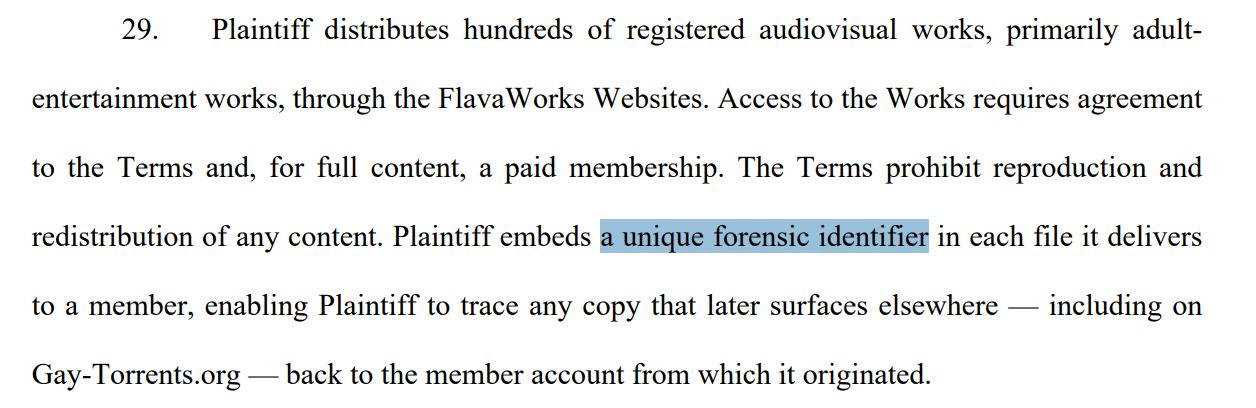
However, FlavaWorks had already infiltrated this digital perimeter. Armed with proprietary forensic watermarking technologies that embed unique, invisible identifiers into every video delivered to subscribers, the company began tracking its copyrighted catalog onto the tracker as early as 2022. Initial cease-and-desist notices sent to suspected repeat offenders—including the man who would eventually become the anchor defendant in the RICO suit—largely fell on deaf ears.
The April Lawsuit and the Collapse of the Site
In April of this year, FlavaWorks made its first major move, filing a sweeping federal lawsuit in Illinois against the operators of Gay-Torrents.org, a Bulgarian shell company, site administrators, and an initial cohort of 325 individual members. This aggressive legal strike struck a fatal blow to the platform. Faced with mounting legal defense costs, imminent asset-freezing orders directed at payment processors like PayPal and Skrill, and severe personal liability, the operators of Gay-Torrents.org pulled the plug, shuttering the platform entirely.
Yet, shutting down the website did not satiate FlavaWorks’ legal ambitions. As the initial lawsuit progressed, the company encountered a common procedural hurdle: federal jurisdictional limits forced the voluntary dismissal or dropping of hundreds of individual defendants who lived outside of Illinois and lacked sufficient minimum contacts with the state. Determined to hold individual participants accountable on a national scale, FlavaWorks restrategized, abandoning pure copyright-and-state-law claims in favor of a federal racketeering framework designed to capture out-of-state conspirators in one unified sweep.
Supporting Context & Metrics: The Mechanics of the RICO Case
The newly filed complaint represents a masterclass in creative legal engineering, weaponizing federal statutes typically reserved for organized crime syndicates against a peer-to-peer file-sharing community.
The "Association-in-Fact" Enterprise
At the heart of the RICO complaint is the characterization of Gay-Torrents.org not merely as a message board or a collection of isolated copyright infringers, but as an "association-in-fact enterprise" with the shared commercial purpose of profiting from the unauthorized distribution of copyrighted works.
Within this structural framework, FlavaWorks categorizes the site’s participants into distinct tiers of culpability:
- Lower-Rung Participants: Members who engaged in the foundational P2P cycle of uploading and downloading infringing content, thereby supplying and maintaining the site’s vast digital inventory while participating in the sharing-ratio system.
- Funders (VIP Members): Users who paid financial fees to upgrade their accounts to VIP status, granting them expedited access, higher download limits, and ad-free browsing.
Wire Fraud and the Multi-Million Dollar "Web-Hosting" Facade
Perhaps the most damaging aspect of the RICO complaint is the allegation of wire fraud leveled against VIP subscribers. FlavaWorks argues that every single financial transaction made for VIP membership was an intentional, fraudulent act designed to mask the illegal nature of the site’s operations from traditional financial institutions.
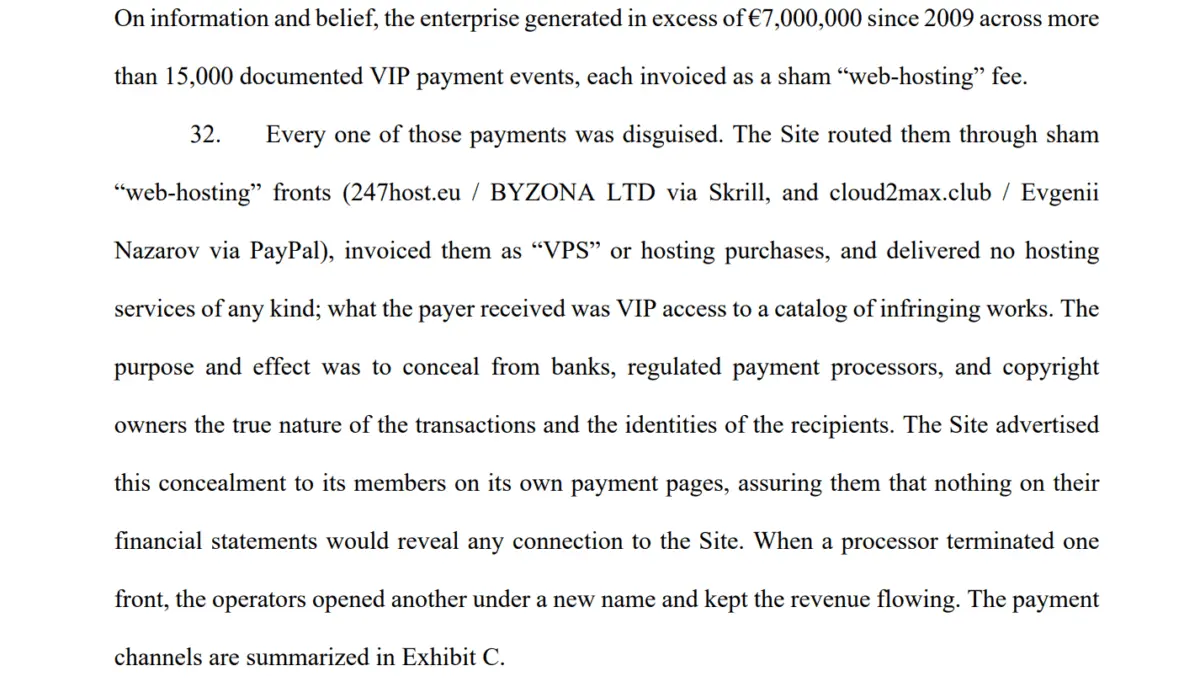
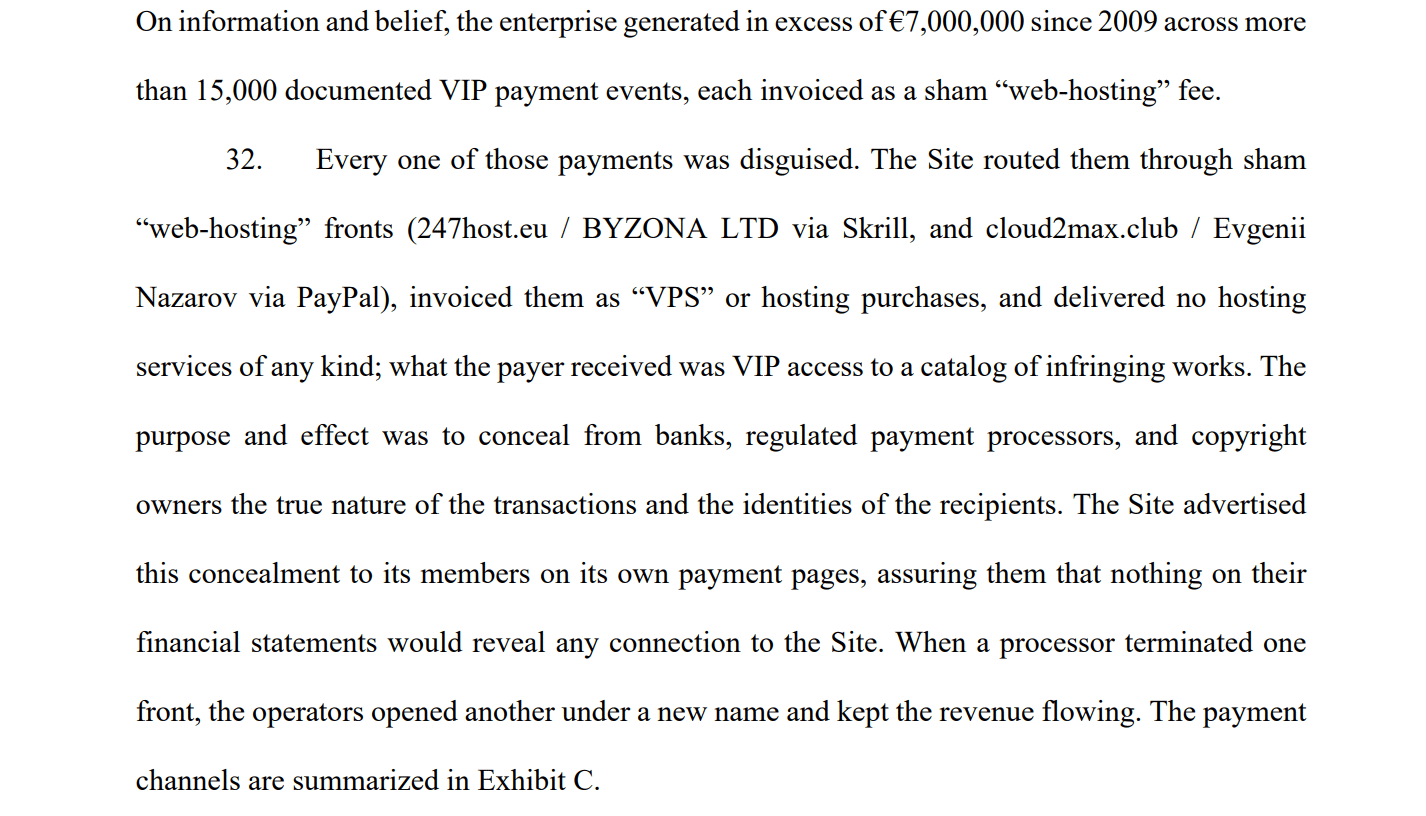
According to the lawsuit, payments were systematically funneled through sham web-hosting fronts, compelling users to purchase non-existent "Virtual Private Server (VPS) plans." By disguising illicit adult-content subscriptions as routine corporate infrastructure expenses, the operators and their financial backers successfully duped banks, credit card companies, and payment processors like Skrill and PayPal.
Financial estimates outlined in the complaint paint a staggering picture of scale. FlavaWorks calculates that the enterprise generated in excess of €7,000,000 since 2009, spanning more than 15,000 documented VIP payment events—each dutifully invoiced as a sham web-hosting fee. This multi-million-euro figure was initially cited in the April litigation to justify sweeping asset-freezing injunctions and forms the backbone of the enterprise’s alleged financial motive.
The Forensic Evidence Trail
Identifying anonymous internet users behind pseudonymous handles on a private tracker is notoriously difficult, but FlavaWorks utilized a multi-layered investigative approach:
- Proprietary Watermarks: The anchor defendant, Jason A. S., was allegedly caught because his active subscription to FlavaWorks’ legal platforms between March 2020 and July 2021 allowed the company to embed unique forensic identifiers into more than 200 downloaded files. When those exact files surfaced on Gay-Torrents.org bearing his unique digital fingerprint, a direct line of provenance was established.
- Undercover Investigation: FlavaWorks deployed private investigators who successfully infiltrated the tracker, purchased VIP subscriptions, and documented the transaction pathways.
- Third-Party Subpoenas: Financial data secured via earlier subpoenas served to payment processors like PayPal and Skrill provided the transaction logs necessary to connect user profiles to actual monetary transfers.
- Internal Site Records: The complaint mysteriously references "the Site’s own per-member records," suggesting that FlavaWorks may have secured database exports, user logs, or administrative records during the collapse and shutdown of the platform.
Legal Strategy: Why RICO Changes Everything
The pivot from traditional copyright litigation to a RICO-based complaint is a calculated tactical maneuver designed to overcome the procedural roadblocks that frequently derail anti-piracy lawsuits.
Overcoming Jurisdictional Boundaries
In standard federal copyright cases, a plaintiff must prove that the defendant resides within the judicial district or has sufficient minimum contacts with the forum state (in this case, Illinois) to satisfy constitutional due process. This often forces copyright holders to file fragmented lawsuits across multiple states or drop out-of-state defendants entirely.
The RICO statute completely alters this dynamic by authorizing nationwide service of process. Under 18 U.S.C. § 1965, if a court has personal jurisdiction over even a single "anchor defendant" residing within the forum state, all other co-conspirator defendants residing anywhere in the United States can be legally hauled into that same court. In this case, Jason A. S. of Virginia serves as the anchor, linking the remaining 74 John Doe defendants—spread across the country—to the Northern District of Illinois.
Magnifying Financial Liabilities and Conspiracy Rules
From a financial standpoint, RICO exponentially increases the pressure on defendants. While standard copyright infringement carries statutory damages of up to $150,000 per willfully infringed work (with the complaint listing 85 distinct copyrighted works), a successful RICO claim introduces treble damages—meaning courts can triple the total assessed damages.
Furthermore, RICO introduces robust conspiracy liability. Under this legal theory, a member who exclusively paid VIP fees and never uploaded a single pirated file can still be held jointly and severally liable for the entire enterprise’s copyright infringement and racketeering activities. This effectively transforms a low-level consumer copyright violation into a federal racketeering offense carrying catastrophic financial consequences.
Future Outlook: Industry Implications and Legal Hurdles
As this landmark case proceeds through the U.S. District Court for the Northern District of Illinois, legal analysts and digital rights advocates are watching closely. The outcome could establish a dangerous precedent for copyright holders seeking to dismantle decentralized or private P2P communities.
High Stakes, High Hurdles
While filing a RICO complaint is an exceptionally effective psychological weapon designed to terrify defendants into swift, out-of-court settlements, actually proving a racketeering case at trial is a vastly different undertaking. The evidentiary bar for RICO is notoriously high. FlavaWorks will be legally obligated to demonstrate:
- A clear, continuous "pattern of racketeering activity."
- Specific, provable instances of wire fraud meeting the strict "who, what, when, and where" evidentiary standard.
- Direct, actionable proof of coordination and conspiracy among disparate users who may have never communicated with one another directly.
A Pyrrhic Victory or a New Enforcement Blueprint?
It remains to be seen whether FlavaWorks intends to take this complex litigation all the way to a jury trial or use the indictment as leverage to secure sweeping default judgments and financial settlements.
In many respects, FlavaWorks has already achieved its primary strategic objective: Gay-Torrents.org is permanently dead, and its digital infrastructure has been dismantled. Every financial recovery, settlement check, or legal concession extracted via the new RICO complaint functions essentially as a bonus for the adult entertainment producer.
For the average consumer and participant in private file-sharing ecosystems, however, the message is unmistakably clear. The era of operating behind closed registration walls, pseudonymous handles, and purported shell companies offers diminishing protection. As aggressive rightsholders adopt sophisticated forensic tracking and aggressive federal racketeering statutes, the legal risks associated with digital piracy have evolved from routine copyright disputes into existential threats.