









Executive Overview
In the intricate and ever-shifting landscape of search engine optimization, few concepts are as foundational—yet frequently misunderstood—as the crawl budget. Recently, Google updated its official "Crawling infrastructure" documentation, introducing a pivotal new section titled "Optimize your crawl budget." This release arrives at a critical juncture for digital publishers, e-commerce giants, and enterprise website administrators alike. With billions of active URLs populating the modern web, Google’s automated web-crawling bots (most notably Googlebot) face unprecedented resource constraints.
For a web page to appear in Google’s index and, subsequently, drive organic traffic via search engine result pages (SERPs), it must first be discovered and crawled. However, because Google operates on a finite resource allocation model designed to protect its own infrastructure and prevent overwhelming target servers, not every page on the internet is crawled with equal frequency or priority.
The newly revised guidelines provide a much-needed roadmap on how webmasters can expose more of their content to Google’s bots. By breaking down how crawl budgets are allocated, how they scale over time, and why technical parameters like site speed, strategic content deployment, and HTTP status codes matter, Google has offered actionable insights into the mechanics of indexation. This comprehensive report explores the nuances of Google’s updated documentation, analyzes the underlying mechanics of crawl budgets, provides strategic context, and evaluates expert recommendations—such as the controversial caveat surrounding "URL caching" and 304 HTTP status codes—to help site owners maximize their search visibility.
Detailed Chronology & Background: The Evolution of Crawl Budget Management
To fully understand the weight of Google’s recent documentation update, it is necessary to examine how crawl budget management has evolved over the past decade.
The Early Days of Unlimited Discovery
In the early iterations of web search, search engines attempted to crawl every accessible link encountered on the internet. As the web expanded exponentially, this brute-force approach became unsustainable. Servers hosting poorly optimized websites buckled under the sheer weight of automated bot traffic, leading to site slowdowns and outright outages. Consequently, search engines developed the concept of a "crawl budget"—a self-imposed limit on how many pages, and how frequently, a search engine bot will crawl a specific website within a given timeframe.
The Rise of Enterprise-Scale Complexity
As e-commerce platforms, dynamic web applications, and user-generated content networks expanded, the scale of individual websites grew from hundreds of pages to millions. Massive e-commerce platforms often inadvertently generate millions of low-value, duplicate, or faceted navigation URLs. Without proper crawl budget management, Googlebot could spend weeks indexing parameter-heavy filter pages while ignoring core product pages or newly published editorial content.
Recognizing these systemic challenges, Google periodically refines its developer documentation to demystify how its bots interact with web infrastructure. The latest update to the "Crawling infrastructure" documentation marks a significant step toward transparency. By explicitly detailing how crawl budgets are initialized, how they scale, and what technical triggers influence bot behavior, Google has shifted from an opaque algorithmic black box to a more cooperative, standards-based relationship with site administrators.
Core Takeaways from the New Google Guidelines
Google’s updated guidelines provide a granular look at the factors influencing crawl allocation. Understanding these principles allows developers and SEO practitioners to align their site architecture with Googlebot’s operational preferences.
1. The Conservative Beginning: Every New Site Starts Small
When a brand-new website launches, it is met with a "conservative" crawl budget by default. Google’s algorithms do not inherently know whether a new server can handle heavy concurrent requests from automated crawlers.
- The Strategy: When launching a new site or a massive subdomain, site owners should introduce a modest, controlled number of pages.
- The Rationale: This ensures that Googlebot can thoroughly cover all critical content without inadvertently overloading the host server, causing latency issues, or triggering rate-limiting protocols. As the server proves its reliability under load, Google’s systems gradually build confidence in the site’s infrastructure.
2. Scaled Growth: Matching Content Expansion with Technical Maturity
A crawl budget is not a static metric; it is dynamic and evolves over time. As a website grows in scale and demonstrates a reliable cadence of updates, its crawl budget naturally increases.
- The Mechanism: Regular updates—particularly when cleanly packaged and automatically communicated to Google via XML sitemaps—signal to Googlebot that the site is actively maintained. This encourages the bot to return more frequently.
- Practical Application for E-Commerce: For online retailers, pacing is everything. Dropping 100,000 new product pages into a database overnight on a brand-new domain is a recipe for indexation disaster. Google recommends a measured, gradual approach. For instance, rather than launching an entire inventory catalog at once, e-commerce managers should consider rolling out roughly three products per day over the course of a month. This steady stream of fresh content trains Googlebot to check the site consistently.
3. The Indispensable Role of Site Performance and Load Time
The correlation between website performance and crawl efficiency is absolute. It has long been an axiom of technical SEO that faster websites are crawled more efficiently, but Google’s latest updates reinforce this reality with renewed emphasis.
- Server Response Times: If a server takes three seconds to respond to an HTTP request, Googlebot can only process a fraction of the pages it could have parsed if the server responded in 200 milliseconds.
- Actionable Monitoring: Site administrators must continuously monitor their site’s performance metrics utilizing developer tools like Google Search Console, Lighthouse, and Core Web Vitals diagnostics. Proactively reducing server latency and optimizing resource delivery directly translates to an expanded and more active crawl budget.
4. Popularity and PageRank: The Link Equity Factor
Crawl frequency is heavily influenced by a page’s perceived importance within the global web ecosystem, which is largely determined by link topology.
- Inbound Links: Pages that accumulate a high volume of quality inbound links—both external backlinks from authoritative third-party domains and internal links from high-traffic pages within the same site—are prioritized by Googlebot.
- Crawl Pathways: Because internal linking structures dictate how bots navigate from a root domain to deep-level pages, orphan pages (pages with no internal links pointing to them) struggle immensely to capture crawl budget attention. Strengthening internal link architecture ensures that link equity and crawl bots flow seamlessly to vital conversion pages.
Deep Dive: The Mechanics of the "Crawl Stats" Report
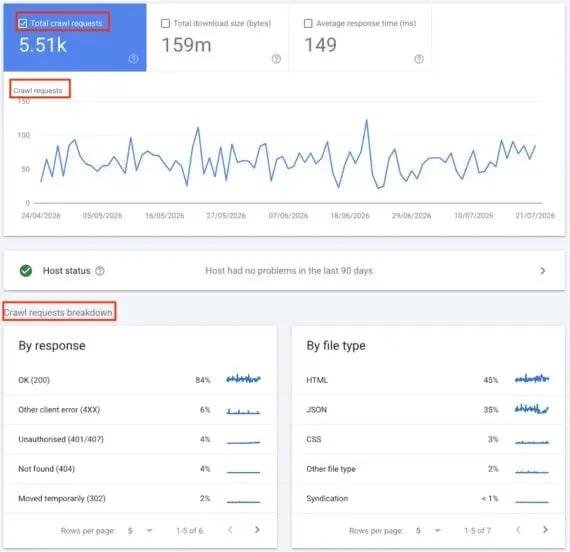
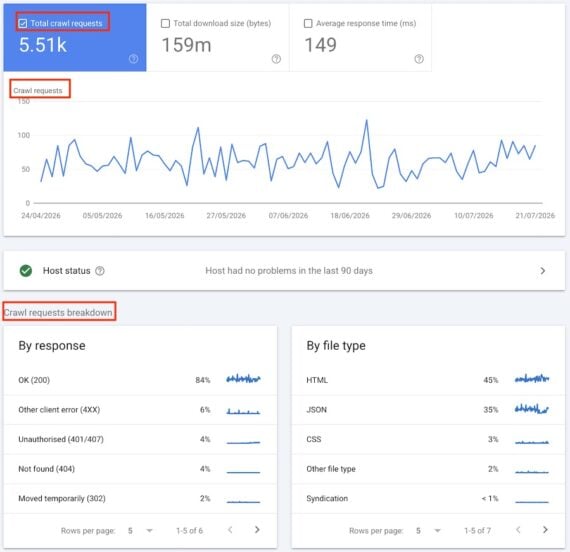
To effectively manage and diagnose crawl budget limitations, webmasters must look directly at Google Search Console’s Crawl Stats report. This diagnostic dashboard serves as an X-ray machine for a website’s technical health, shedding light on how Googlebot interacts with server architecture on a day-to-day basis.
[Googlebot] ---> Requests Server ---> [HTTP 200/304/404/5xx] ---> Logged in Search Console "Crawl Stats"Key Metrics Tracked in Crawl Stats:
- Total Requests: Shows the aggregate volume of requests Googlebot made to the site over a selected period (daily, weekly, or monthly). Spikes or sudden drops often indicate server errors or massive algorithmic adjustments.
- Total Download Size: Measures the amount of data transferred during crawls. Bloated CSS, unminified JavaScript, and oversized images consume valuable bandwidth and can artificially restrict how many pages Googlebot can process within its time limit.
- Average Response Time: Illustrates how quickly the server responds when Googlebot knocks. A rising response time graph is an immediate warning sign that server resources are bottlenecking, which will inevitably lead to a reduced crawl budget.
- Response Status Breakdown: Categorizes server responses by HTTP status code (e.g., 200 OK, 304 Not Modified, 404 Not Found, 5xx Server Errors). High rates of 5xx errors act as an immediate signal to Googlebot to back off, sharply curtailing crawling activity to prevent crashing the host server.
By routinely auditing the Crawl Stats report, technical SEO professionals can spot anomalies—such as rogue bot traps, infinite pagination loops, or unexpected server slowdowns—before they severely degrade index coverage.
Official Recommendations vs. Real-World Execution: The "URL Caching" Debate
One of the most noteworthy additions to Google’s updated documentation centers around the concept of URL caching and the strategic utilization of HTTP status codes. While Google’s official guidance provides clear technical parameters, experienced SEO practitioners often find that blindly following automated recommendations can carry unintended risks.
The Official Google Recommendation on 304 Status Codes
Google’s documentation explicitly highlights the utility of the 304 (Not Modified) HTTP status code:
"Support 304 (Not Modified) HTTP status codes. If a page hasn’t changed since Google last crawled it, returning a 304 code tells Google to reuse the cached version, saving your server bandwidth and resources."
On paper, this is a masterclass in efficiency. For massive enterprise sites generating terabytes of log data and handling millions of daily bot requests, serving a 304 status code eliminates the need to transmit the full HTML payload of an unchanged page. It conserves server CPU cycles, reduces bandwidth expenses, and allows Googlebot to utilize its allocated time window more productively.
The Expert Caveat: Proceed with Caution on Critical Pages
Despite the technical elegance of 304 status codes, veteran SEO strategists advise caution regarding where and how this technique is deployed.
- The Risk of Stale Signals: Telling Google via a 304 response code that a page remains completely unchanged over an extended period can sometimes backfire. If a page’s underlying content, structured data, or internal context subtly shifts without triggering a header modification date, prolonged reliance on cached versions can hinder fresh evaluations.
- Impact on SERP Visibility and Index Status: Over-utilizing 304 responses on high-value, dynamic commercial pages can inadvertently signal to search algorithms that the content is static, stagnant, or low-priority. In competitive verticals, search engines favor freshness and active iteration.
- Recommended Best Practices:
- Safe Zones for 304s: Implement 304 status codes primarily for low-priority, static architectural assets—such as deep archive pages, expired product placeholders, legal disclosures, terms of service agreements, and standard privacy policy documents.
- Dynamic Zones to Avoid: Exercise restraint when implementing aggressive caching mechanisms on high-velocity e-commerce category pages, frequently updated blog posts, and core landing pages where real-time indexing of new copy, price changes, or promotional banners directly impacts conversion rates.
Future Outlook: The Intersection of Crawl Budgets and AI-Driven Search
As the digital ecosystem transitions from traditional keyword-matching search engines to sophisticated, generative, AI-driven retrieval systems (such as Google’s Search Generative Experience and AI Overviews), the role of crawl infrastructure is undergoing a radical paradigm shift.
1. Real-Time Indexing Pressures
In an era where users expect instantaneous answers synthesized by artificial intelligence, the latency between content publication and indexation must approach zero. As AI models continuously ingest and summarize web data to answer complex queries, websites that fail to optimize their crawl budgets will find themselves excluded from real-time AI knowledge bases. Publishers can no longer afford to wait weeks for Googlebot to slowly traverse an unoptimized site architecture.
2. The Automation of Server Optimization
Looking ahead, we can anticipate further convergence between automated server resource management and search engine protocols. Future iterations of web infrastructure may feature deeper integrations between content delivery networks (CDNs), edge computing platforms, and search engine crawlers, allowing dynamic, real-time negotiation of crawl intensity based on live server loads.
3. Sustainability and Green Web Hosting
With environmental considerations taking center stage globally, minimizing the carbon footprint of web crawling is becoming a priority. Inefficient websites that force search engine bots to download bloated, uncompressed files waste massive amounts of electricity across global data center networks. By streamlining code, improving load times, and properly utilizing caching mechanisms like 304 status codes, site owners not only improve their SEO performance but also contribute to a more sustainable, energy-efficient internet.
Conclusion
Google’s updated "Crawling infrastructure" documentation serves as a timely reminder that technical SEO is not a "set-and-forget" exercise. Understanding and optimizing your website’s crawl budget is essential for ensuring that your digital footprint is fully recognized, indexed, and surfaced in an increasingly competitive search landscape.
By starting new ventures with conservative footprints, scaling content updates thoughtfully, prioritizing ruthless server performance optimization, strengthening internal linking topologies, and judiciously applying HTTP status codes like the 304, site administrators can forge a harmonious relationship with Googlebot. In an online world governed by finite resources, mastering crawl efficiency is the ultimate competitive advantage.