Executive Overview
The United States Postal Service (USPS) is charting a radically new strategic course as it continues to grapple with a protracted liquidity crisis. Faced with deep-seated financial imbalances, leadership at the quasi-governmental agency is signaling a definitive departure from the historical volume-chasing models that once defined modern postal operations. Moving forward, the Postal Service intends to lean heavily into aggressive pricing strategies, demonstrating a willingness to sacrifice overall package and mail volume if higher rates translate to a healthier net revenue intake.
This strategic pivot was crystallized during the USPS Board of Governors open session on August 7, 2026. Postmaster General and CEO David Steiner addressed the agency’s fiscal standing, pointing to recent quarterly earnings as empirical proof that selective price hikes can successfully offset declining shipment counts. While operating revenues have experienced a modest uptick, the structural realities of running a nationwide delivery network mandated by Congress continue to weigh heavily on the organization’s balance sheet.
For ecommerce merchants, third-party logistics providers, and retail consumers, this emerging paradigm carries profound implications. For years, the postal network functioned as an indispensable, cost-effective outlet for lightweight residential shipments and hard-to-reach rural geographies. However, as the USPS recalibrates its financial compass to prioritize yield over sheer volume, stakeholders across the retail supply chain must prepare for a pricing landscape defined by continuous increases—with another potential wave of rate adjustments looming ominously on the horizon ahead of the peak holiday shipping season.
Detailed Chronology: Financial Performance and Strategic Realignment
The genesis of this strategic pivot can be traced through the financial disclosures and operational data released during the fiscal third quarter of 2026. Covering the period ending June 30, 2026, the quarterly report provided leadership with the empirical validation necessary to accelerate its pricing agenda.
During this three-month window, the USPS reported a total operating revenue of $19.9 billion, representing a 6.1% increase compared to the corresponding period in the previous fiscal year. Concurrently, the agency’s net loss narrowed from $3.1 billion down to $2.5 billion. While a multi-billion-dollar net loss would trigger alarm bells in the private corporate sector, within the context of the Postal Service’s historically troubled ledger, the contraction was viewed by leadership as a step in the right direction—and, crucially, proof that pricing levers are working as intended.
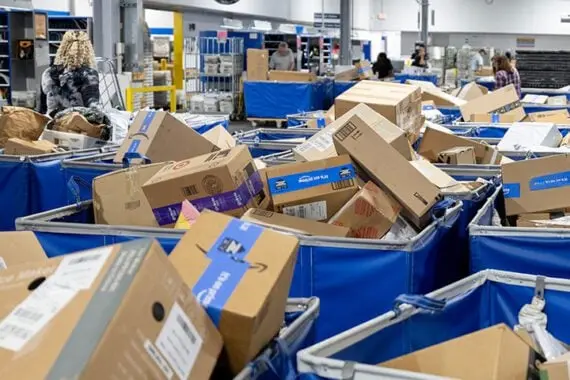
A deeper dive into the shipping and packages sector of the report highlights the mechanics of this strategy. Shipping and packages generated $8.25 billion in revenue during the third quarter, marking a solid year-over-year increase of $588 million, or 7.7%. Paradoxically, this financial gain was achieved alongside a contraction in volume. Total package volume declined by 55 million pieces, representing a 3.4% drop compared to the prior year.
In simple terms, the USPS generated significantly more capital while handling significantly fewer boxes. This counter-intuitive outcome was driven by a confluence of factors, including the continued organic growth of USPS Ground Advantage—the agency’s consolidated ground shipping service—and the implementation of a temporary, transportation-related price increase introduced in April across select parcel services.
Rather than viewing the volume drop as a failure of market share retention, postal leadership interpreted the contraction as a sign of under-priced elasticity. The market absorbed the higher rates without catastrophic churn, confirming that the agency has not yet reached the ceiling of its pricing power.
Supporting Context & Metrics: The Economics of Volume Versus Yield
To fully appreciate the gravity of the USPS’s new operational philosophy, one must examine the economic models that have governed postal services for decades. Historically, the prevailing wisdom among logistics strategists was straightforward: fill the trucks, maximize facility throughput, and saturate delivery routes. Because the Postal Service is legally mandated to maintain a universal service obligation—delivering to every single address in the United States, from bustling Manhattan high-rises to remote Alaskan homesteads—fixed overhead costs remain exceptionally high regardless of daily volume fluctuations.
Under the traditional "fill-the-truck" mentality, ecommerce growth was widely viewed as the ultimate panacea. As consumer habits shifted decisively toward online shopping, merchants flooded the postal network with lightweight residential parcels. The logic suggested that any incremental package helping to offset the terminal, multi-decade decline in First-Class Mail volume was inherently beneficial, even if profit margins per piece were razor-thin. Retailers eagerly embraced this dynamic, utilizing the USPS to bypass the punitive rural delivery surcharges frequently levied by private, for-profit carriers like FedEx and UPS.
However, Postmaster General Steiner and his executive team are actively dismantling this assumption. Maximizing volume is no longer conflated with maximizing financial health. The Q3 fiscal 2026 metrics provide a masterclass in this alternative economic calculus: shedding 55 million packages while simultaneously capturing an additional $588 million in revenue fundamentally alters the cost-to-serve equation.
This pricing behavior mirrors standard commercial practices found in private industries governed by supply-and-demand elasticity—such as commercial aviation or grocery retail. In these sectors, operators deliberately manage capacity and raise prices to optimize profitability, accepting that a smaller volume of higher-paying customers yields a more resilient business than operating at maximum capacity with unsustainable margins.
Crucially, this dynamic is not restricted to parcel delivery; it applies equally to market segments where the Postal Service commands a historic monopoly. First-Class Mail revenue climbed 4.3% during the same quarterly period, even as physical mail volume dropped by 3.5%. Regulatory frameworks heavily restrict how aggressively the quasi-governmental agency can raise rates on monopoly products, yet the agency continues to test the outer boundaries of its statutory limits. Despite operating under unique regulatory constraints, the USPS is increasingly behaving like a commercial enterprise driven by yield management.
Official Statements and Leadership Perspectives
The ideological anchor of this strategic realignment was driven home by Postmaster General and CEO David Steiner during his address at the USPS Board of Governors open session on August 7, 2026. Steiner’s remarks left little doubt regarding the organization’s future trajectory, framing aggressive pricing not merely as an option, but as an absolute corporate necessity.

"The results this quarter show the strong leverage that pricing can have on results, and pricing is one lever that we have to use now to grow revenue," Steiner stated during the assembly.
Expanding on the elasticity data observed throughout the quarter, Steiner emphasized that the agency’s tolerance for rate adjustments remains robust. The market data, in his view, commands a continuation of current tactics.
"All of the statistics and results show that we have yet to cross the point that we should be changing our pricing strategy, and that we have more price [increases] to take in the marketplace," Steiner asserted. "It would be financially irresponsible of us not to do so."
Drawing direct parallels to private sector pricing philosophies, Steiner defended the departure from volume-maximization goals.
"Thus far, applying those basic principles has favored raising prices even though there has been a modest decrease in volumes," he explained, reinforcing the notion that the USPS must prioritize fiscal sustainability over market-share accumulation.
Yet, even as Steiner championed aggressive pricing as an immediate operational fix, he issued a stark reality check regarding the ultimate limitations of administrative strategy. Pricing adjustments alone, he argued, cannot heal an institutional model that he deems fundamentally broken.
"As things stand, the Postal Service is expected to be self-sustaining while, at the same time, fulfilling mandates that are inherently unsustainable and do not cover their costs," Steiner warned. "We need to fix the business model that has produced the 17-year-long imbalance in costs and revenue — and that is going to require Congressional involvement."
This duality in leadership messaging is telling: while executive management will pull every pricing lever at its disposal to keep the agency solvent in the near term, structural viability remains entirely dependent on legislative reform in Washington.
Future Outlook: Implications for Ecommerce and the Supply Chain
As the USPS accelerates its pivot toward yield-managed pricing, the downstream effects will reverberate across the broader ecommerce ecosystem. Online merchants, direct-to-consumer brands, and third-party fulfillment centers must recalibrate their logistics strategies to account for an increasingly expensive postal partner.
1. The Erosion of Low-Cost Last-Mile Advantage
For years, the Postal Service’s competitive edge relied heavily on its ability to offer exceptionally low rates for lightweight parcels (<1 lb) and residential last-mile handoffs. As rate increases compound over successive quarters—and as leadership actively signals a willingness to shed low-margin volume—the historical cost arbitrage of using the USPS for residential deliveries will continue to narrow. While services like Ground Advantage will retain strategic utility due to the sheer ubiquity of the postal delivery network, merchants can no longer treat postal shipping as a bottomless reservoir of cheap capacity.
2. Heightened Volatility Ahead of Peak Season
With leadership confirming that further price adjustments are required to sustain operating revenue, retail merchants must anticipate off-cycle rate hikes and aggressive structural changes. Historical patterns suggest that carriers frequently adjust pricing mechanisms ahead of the high-volume holiday shopping period. Ecommerce brands that rely on predictable shipping budgets must build financial buffers into their fulfillment models to absorb impending rate hikes without eroding product margins or forcing unsustainable shipping fees onto consumers.
3. The Necessity of Multi-Carrier Diversification
The evolving USPS mandate serves as a cautionary tale for modern supply chain executives. Over-reliance on any single carrier—whether it be the Postal Service, FedEx, UPS, or regional parcel networks—exposes retail operations to acute margin compression. Moving forward, sophisticated merchants will increasingly leverage dynamic multi-carrier shipping software to algorithmically route parcels based on real-time rate shopping, ensuring that packages are distributed optimally across national, regional, and postal networks.
4. The Specter of Legislative Intervention
Ultimately, Steiner’s sobering assessment that the postal business model requires congressional intervention hangs like a cloud over the industry. True structural reform would require lawmakers to address the complex obligations tied to retiree health benefits, universal service mandates, and archaic labor agreements. Until Congress acts, the Postal Service has only a finite set of tools to stave off insolvency. Raising prices, managing yields, and shedding unprofitable volume will remain the primary defense mechanisms of an agency fighting for its financial survival.
In conclusion, the USPS is undergoing a profound identity transformation. No longer attempting to out-volume private competitors through low-cost ubiquity, the agency is embracing a leaner, yield-focused model that trades package counts for balance sheet stability. For the ecommerce merchants who power the modern retail economy, acknowledging and adapting to this new reality is no longer optional—it is a prerequisite for survival in an increasingly expensive logistics marketplace.