





Executive Overview
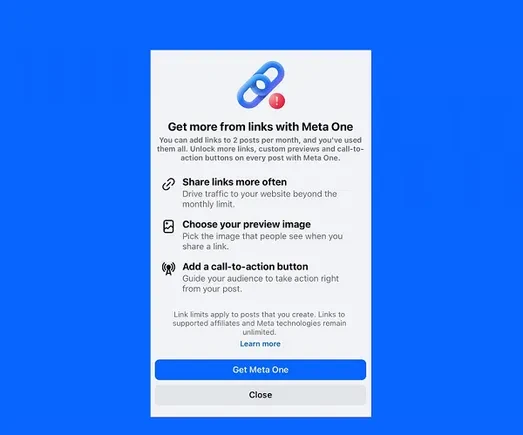
The landscape of digital marketing and social media management is undergoing a profound structural shift. Following the official rollout of the Meta One for Business subscription packages, a growing cohort of professional account managers, business owners, and digital marketers have reported a restrictive new reality on Facebook: their standard, non-paying accounts are being capped at a maximum of two link-bearing posts per month.
While initial iterations of Meta One focused heavily on expanding functional capabilities—such as allowing a tiered, limited number of outbound links in Instagram posts and Reels—the tech giant now appears to be aggressively scaling its Facebook-centric link limits. This move broadens a trial phase that first surfaced in December 2025, signaling that Meta is systematically transitioning basic, organic outbound linking into a monetized, premium feature for commercial entities.
For years, the foundational promise of social media for businesses was the free distribution of content bridged by outbound links driving traffic to external websites, e-commerce stores, and editorial content. This latest maneuver accelerates the erosion of that organic paradigm. However, an analysis of Meta’s own transparency reports and long-term monetization strategies reveals a more complex narrative. Outbound links on Facebook have faced a severe, multi-year algorithmic decline in visibility, begging the question: Is Meta charging businesses for a high-value marketing tool, or are they simply formalizing the death of organic outbound traffic on the platform?
This comprehensive report examines the rollout of Meta One for Business, the mechanics of the new link-capping tests, historical platform trends, official justifications, and what this strategic pivot means for digital marketers navigating the modern social media ecosystem.
Detailed Chronology: From Organic Freedom to Tiered Paywalls
To understand how Meta arrived at its current monetization strategy, it is essential to trace the timeline of how outbound links have been handled, restricted, and eventually commodified across Facebook and Instagram.
The Organic Era and the Shift to "Walled Gardens"
In the early days of commercial adoption on Facebook, business pages enjoyed relatively unhindered organic reach. Brands could post links to external landing pages, blogs, and product listings, expecting a reasonable percentage of their follower base to see and click those links. However, as the platform matured and user feeds became saturated, Meta (then Facebook Inc.) steadily adjusted its algorithms to favor native content—content that kept users inside the Facebook ecosystem. Videos, native photos, and text posts began outperforming posts with external URLs.
December 2025: The Initial Link-Capping Test
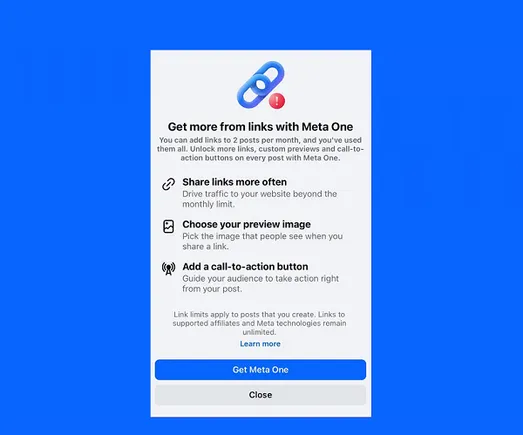
The precursor to the current controversy arrived quietly in December 2025. During this period, select Facebook Pages worldwide began noticing subtle pop-up notifications warning them that their ability to post links was entering a trial phase. Under this initial test, these specific commercial accounts were restricted to a meager allowance of two link posts per calendar month.
At the time, Meta defended the test by stating it was evaluating whether a higher volume of link posts genuinely added value for page administrators, while simultaneously carving out exemptions for recognized publisher pages to prevent news deserts and maintain platform content flow.
The Launch of "Meta One for Business"
The friction between organic limitations and corporate monetization reached a boiling point with the debut of the Meta One for Business subscription packages. Marketed as a comprehensive upgrade for professional accounts, Meta One introduced tiered subscription pricing designed to bundle various administrative, analytical, and promotional tools.
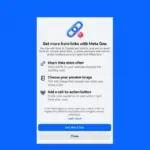
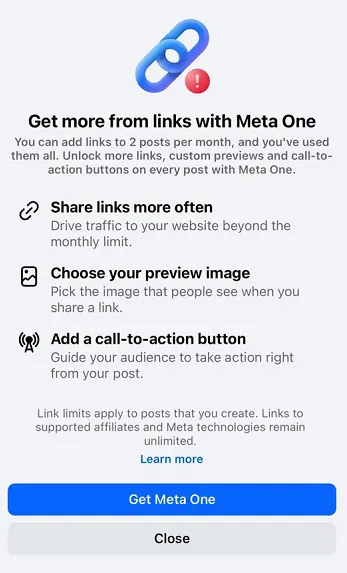
Among these bundled features were elevated allowances for adding outbound links to Instagram posts and Reels—a clear indicator that link distribution was transitioning from a universal utility to a gated feature. Within days of the Meta One launch, the December 2025 trial expanded drastically. Facebook managers across multiple sectors began receiving system alerts informing them that their accounts were now subject to the two-link-per-month ceiling unless they upgraded to a paid Meta One tier.
Supporting Context & Metrics: The Death of Organic Link Exposure
While charging businesses to post links may feel like an aggressive shake-down to marketing professionals, raw data from Meta’s own transparency metrics offers a compelling counter-narrative: organic link posts on Facebook barely get any visibility anyway.
Insights from the Widely Viewed Content Report (Q1 2026)
Meta publishes its Widely Viewed Content Report to offer transparency regarding what content actually captures user attention across the platform in the United States. The metrics paint a stark picture of how Facebook users consume media:

- The 98.7% Rule: According to the Q1 2026 Widely Viewed Content Report, an astounding 98.7% of all post views in the U.S. did not include a link to a source outside of Facebook.
- A Multi-Year Freefall: The systemic suppression—or natural user avoidance—of outbound links is not a sudden anomaly. Longitudinal data shows that in 2022, when Meta first began publishing these specific insights, roughly 9.8% of viewed content included an external link. By the time the Q1 2026 report was compiled, that figure had plummeted to an all-time low of 1.3%.
[2022]  ██████████ 9.8% of viewed content included a link
[2026]  █ 1.3% of viewed content included a link
What the Data Means for Marketers
When evaluating these statistics, the implications for business accounts become complex:
- Low Baseline Impact: Because the algorithm already deprioritizes outbound links to keep users engaged on-site, the actual reach lost by being restricted to two link posts per month may be negligible for many brands. If 98.7% of feed views already ignore external URLs, the organic traffic value of un-boosted link posts was already near zero.
- The Pay-to-Play Imperative: If a business relies heavily on driving direct, organic traffic via free posts, the new cap severely damages their workflows. However, Meta’s data suggests that brands wishing to drive traffic have long relied on paid advertising (Meta Ads) rather than organic posting to achieve meaningful click-through rates.
Official Statements and Strategic Alignment
Meta’s defense of these changes rests on two primary pillars: platform value optimization and a long-standing, predictable corporate monetization framework.
The Three-Stage Playbook
To contextualize Meta’s actions, industry analysts frequently revisit the foundational business strategy laid out by CEO Mark Zuckerberg during the company’s annual stockholder meetings. Zuckerberg outlined a classic three-stage monetization strategy for scaling digital ecosystems:
- Build the Consumer Base: Attract a massive, highly engaged audience by offering completely free, utility-rich consumer applications.
- Encourage Business Adoption: Invite businesses, brands, and creators onto the platform for free to build out a robust commercial ecosystem, driving even more content and utility for consumers.
- Monetize Access: Once businesses are deeply entrenched and reliant on the platform’s audience, systematically introduce paid tiers, advertising dependencies, and subscription paywalls for core commercial features.
Viewed through this lens, the implementation of Meta One for Business and the restriction of organic links is not an unexpected glitch or an isolated cash grab; it is Stage Three execution.
Publisher Exemptions and Exceptions
Recognizing the vital role that news organizations and media outlets play in maintaining user engagement, Meta has maintained specific exemptions for recognized publisher pages throughout these tests. By shielding traditional publishers from the link caps, Meta attempts to mitigate public backlash regarding the suppression of free information while still squeezing commercial brands, e-commerce stores, and service providers into paid subscription models.
Future Outlook: Adapting to the Post-Organic Link Era
The expansion of Meta One link restrictions forces marketing teams, small business owners, and enterprise brands to re-evaluate their social media distribution strategies. As platforms increasingly lock down outbound utility behind subscription tiers and ad spends, the following shifts are expected to define the future of digital marketing on Facebook and Instagram:
1. The Rise of "Zero-Click" Content Strategies
Marketers must fully embrace the concept of zero-click content—providing complete value, storytelling, and brand awareness directly within the native post format (carousels, native video, text, and graphics). Instead of using social media as a direct "pipe" to drive traffic to a blog or product page, brands must use social platforms to build brand equity, community, and top-of-funnel awareness, directing users to bio links or utilizing paid ad placements for direct conversion.
2. Strategic Budget Reallocation
Businesses must perform cost-benefit analyses on Meta One for Business subscription tiers. For brands where Facebook is a primary customer acquisition channel, paying a monthly subscription fee to lift link caps may become a standard operational expense, akin to software-as-a-service (SaaS) tool subscriptions. Alternatively, brands may find that reallocating those funds directly into targeted Meta Ads yields a vastly superior return on investment compared to organic link posting.
3. Diversification Beyond Meta
The ongoing evolution toward pay-to-play ecosystems underscores the fundamental risk of relying too heavily on any single rented platform. Forward-thinking digital strategies will increasingly prioritize owned channels—such as email newsletters, SMS marketing, and community-owned forums—where algorithm changes and sudden corporate subscription paywalls cannot abruptly disrupt customer communication.
Conclusion
Meta’s decision to expand its test of restricting organic link posts on Facebook to just two per month—unless upgraded to a Meta One for Business subscription—is a watershed moment for social media management. While the move carries strong undertones of a classic "bait-and-switch" monetization play, hard data demonstrates that organic link visibility on Facebook was already dwindling toward irrelevance.
For professional accounts, the path forward requires abandoning outdated organic playbooks. Whether by absorbing the cost of Meta One subscriptions, shifting budgets to paid ad infrastructure, or mastering native, zero-click content creation, businesses must adapt quickly to Meta’s hardened pay-to-play paradigm.