








Executive Overview
For a quarter of a century, the landscape of Digital Asset Management (DAM) has undergone a relentless, structural metamorphosis. Industry veteran Laurent Groult, reflecting on twenty-five years at the vanguard of the field, has witnessed the evolution from physical couriers superseded by early FTP protocols to the modern era of generative artificial intelligence and machine learning. Today, advanced AI algorithms are capable of reading, tagging, indexing, and cross-referencing vast digital archives at a velocity no human workforce could ever hope to replicate.
Yet, this technological leap has ignited a profound existential debate across the information science sector: If artificial intelligence can autonomously generate comprehensive metadata at machine scale, does the traditional DAM librarian still have a purpose?
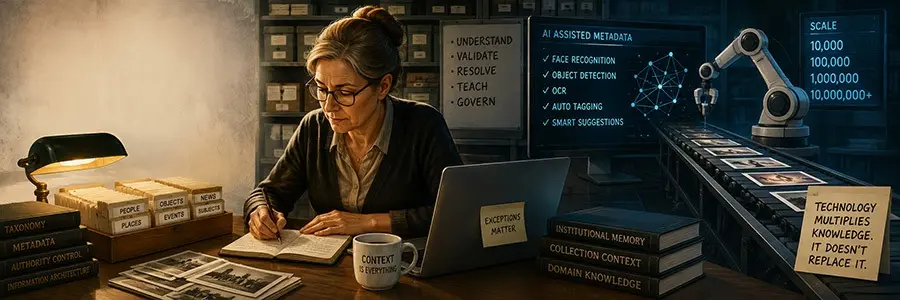
In a compelling new feature published on DAM News titled "The Librarian Isn’t Disappearing—The Keyboard Is," Groult confronts this industry-wide anxiety head-on. He argues that the true value of a DAM professional was never found in the mechanics of typing keystrokes or executing repetitive administrative cataloguing. Instead, true value resides in the nuanced, cumulative human judgment applied to objects, catalogs, and cultural collections over decades of professional practice.
While AI possesses the capability to scale this expertise, it can only do so if a human architect first teaches the machine what constitutes "correctness." Groult cautions that organizations ignoring this distinction risk transforming simple operational speed into enterprise-wide catastrophe. As machine learning reshapes the architecture of modern enterprise archives, the future of digital asset management will not rely on eliminating human oversight, but on redirecting it toward training, curating, and safeguarding the integrity of organizational knowledge.
Detailed Chronology: Twenty-Five Years of DAM Evolution
To fully grasp the paradigm shift currently underway, it is necessary to examine the historical trajectory of Digital Asset Management over the last quarter-century. The discipline has evolved through distinct technological phases, each redefining the relationship between human custodians and digital repositories.
Phase 1: The Analog-to-Digital Transition (Late 1990s – Early 2000s)
In the formative years of digital asset management, the industry was primarily concerned with physical transport and basic digitization. High-resolution imagery, video masters, and marketing collateral were still largely analog or stored on fragile physical media. The transition from physical couriers and magnetic tapes to File Transfer Protocol (FTP) servers represented the first major technological leap. During this era, "librarianship" meant imposing order on unstructured digital folders, establishing rudimentary folder hierarchies, and manually embedding basic metadata via text files.
Phase 2: The Rise of Enterprise DAM and Structured Taxonomies (Mid 2000s – 2010s)
As corporate digital footprints expanded exponentially, basic folder structures proved inadequate. Dedicated Digital Asset Management platforms emerged as centralized software ecosystems. This period codified the role of the DAM librarian as a master taxonomist. Professionals spent countless hours designing metadata schemas, controlled vocabularies, and rights-management frameworks. Cataloguing remained a deeply manual, labor-intensive process. Every asset ingested into the system required human eyes to review, categorize, and tag.
Phase 3: The Automation and Ingestion Boom (Late 2010s – Early 2020s)
The introduction of early computer vision and automated optical character recognition (OCR) began to chip away at manual data entry. Systems could automatically detect faces, basic objects, and dominant color palettes. However, these early tools were fragile, prone to misidentification, and lacked deep contextual awareness. Human oversight remained the definitive bottleneck and safety net for enterprise-grade asset libraries.
Phase 4: The Generative AI Era (Present Day and Beyond)
Today, we have entered an era defined by large-scale multimodal AI models capable of complex semantic analysis. These systems do not merely recognize objects; they interpret context, summarize video files, generate descriptive alt-text, and cross-reference assets against enterprise data lakes in milliseconds. As Groult points out, the mechanical barrier of data entry has effectively vanished. The friction that once justified the time spent cataloguing individual records has evaporated, forcing a radical re-evaluation of the profession’s core function.
Supporting Context & Metrics: The Mathematics of Machine-Scale Error
The core thesis of Groult’s analysis centers on a sobering realization regarding operational scale and error rates. When organizations contemplate adopting AI-driven metadata generation, they frequently focus on labor cost savings and throughput velocity. However, they frequently overlook the mathematical realities of automated error propagation.
As Groult famously notes in his feature:
"A human being can make an error on fifty photographs during an afternoon of cataloguing. A machine can make the same error on five million assets before lunch."
This stark contrast highlights the fundamental danger of confusing operational speed with efficiency. In traditional manual workflows, human error is naturally bounded by physical limitations. A cataloguer experiencing fatigue might mislabel a batch of images, but the scope of the mistake is inherently restricted by human output capacities. Furthermore, manual review processes—such as peer review, supervisory spot-checks, and multi-tiered ingestion pipelines—frequently catch these anomalies organically.
Conversely, AI models operate at an industrial scale unbound by biological constraints. If an algorithm is trained on biased data, misinterprets a brand logo, or misunderstands a specific corporate nomenclature, it applies that misunderstanding universally across millions of files in mere moments.
The Hidden Costs of Unchecked Automation
- Licensing and Compliance Risks: Misattributed rights management metadata can lead to severe legal liabilities, including copyright infringement, unauthorized asset usage, and costly breaches of external licensing agreements.
- Search Degradation: In a multi-million-asset repository, inaccurate or hallucinated AI tags pollute the search index, rendering legitimate assets undiscoverable and severely diminishing the return on investment (ROI) of the DAM platform.
- Erosion of Client Trust: For media enterprises, creative agencies, and global brands, delivering miscategorized or culturally insensitive assets to external clients or public-facing channels inflicts immediate and severe reputational damage.
Institutional Memory and the Disappearing Apprenticeship
Beyond the immediate mathematical risks of error propagation, Groult’s analysis sheds light on a less tangible, yet equally critical, casualty of hyper-automation: the erosion of institutional memory and the traditional apprenticeship model within information science.
Historically, junior librarians entered the workforce through hands-on cataloguing. By manually processing collections record by record, generation after generation of information professionals developed an intimate, granular understanding of their organization’s archival holdings. They learned the idiosyncratic naming conventions, the historical context behind legacy campaigns, and the unwritten rules governing corporate assets. This process created a living repository of institutional memory—knowledge that frequently lived inside the minds of veteran librarians rather than within structured database fields.
When organizations strip away manual cataloguing tasks in favor of out-of-the-box AI ingestion, they inadvertently dismantle this apprenticeship pipeline. If junior staff no longer interact deeply with the records during ingestion, how does institutional memory form? Furthermore, how do organizations capture domain-specific context that cannot be gleaned purely from pixel analysis or optical character recognition?
An AI model can identify that an image depicts a specific historical figure standing in front of a landmark, but it cannot inherently know the confidential corporate partnership, the strategic brand pivot, or the sensitive legal context that makes that specific photograph unusable for upcoming marketing campaigns. That vital layer of context is precisely the domain-specific knowledge that human experts must supply.
Future Outlook: Teaching the Machine What It Does Not Know
Rather than painting a dystopian picture of professional obsolescence, Groult’s feature offers an empowering roadmap for the future of the DAM specialist. The evolution of the role does not spell the end of the librarian; rather, it marks the definitive end of the keyboard as the primary tool of the trade.
Redefining the Role: From Typist to Trainer
The core argument rests on a reallocation of human capital. As Groult asserts:
- "There is very little value in asking a talented person to spend eight hours performing a repetitive task that a machine can complete in minutes. There is enormous value, however, in asking that same person to spend those eight hours teaching the machine what it does not know."
In this emerging paradigm, the DAM librarian transitions from a reactive data-entry clerk to an active AI curator, ontological architect, and machine trainer. Their responsibilities will shift toward:
- Curating Training Datasets: Ensuring that the data fed into machine learning models is clean, unbiased, and representative of organizational standards.
- Establishing Governance Frameworks: Setting ethical, legal, and operational boundaries within which AI algorithms must operate.
- Contextual Encoding: Translating deep institutional memory, brand guidelines, and tribal knowledge into structured rules and semantic graphs that AI can comprehend and apply.
- Quality Assurance and Oversight: Managing exception queues, auditing automated metadata batches, and continuously refining search algorithms to maintain high enterprise standards.
Conclusion: Guarding the Archives
As enterprises race to integrate artificial intelligence into every facet of digital infrastructure, the warning concluding Laurent Groult’s analysis serves as a vital anchor for industry leadership:
"The greatest danger is not that artificial intelligence will replace the people who understand our archives. It is that organizations will believe it already has."
The future of Digital Asset Management does not depend on eliminating human labor; it depends on preserving human expertise. By automating the mechanical burden of cataloguing while elevating the strategic, cognitive role of the librarian, organizations can harness the immense speed of AI without sacrificing the accuracy, context, and institutional wisdom required to protect their most valuable digital assets.