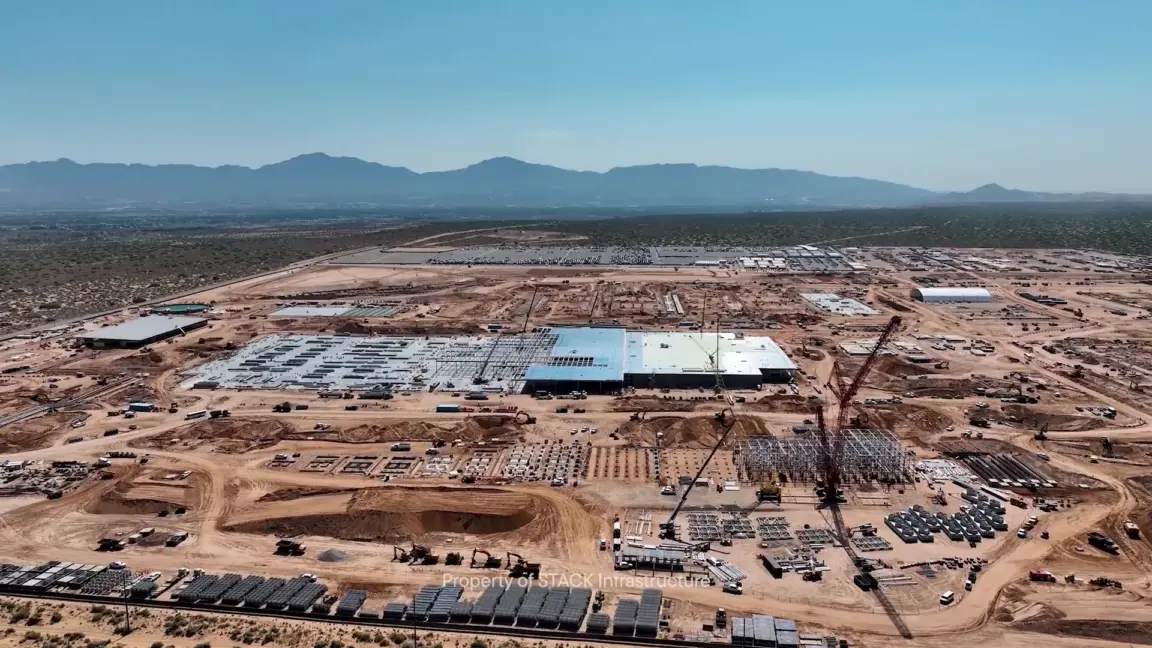
As the global artificial intelligence boom accelerates, the physical infrastructure powering it has collided head-on with ecological realities and fierce community pushback. A striking example of this friction is unfolding in Santa Teresa, New Mexico, where tech giants Oracle and OpenAI are constructing Project Jupiter. Part of the multi-billion-dollar "Stargate" AI infrastructure initiative announced by President Donald Trump in 2025, the sprawling $165 billion data center is designed to feed the insatiable energy appetites of next-generation large language models.
Yet, Project Jupiter has become a lightning rod for environmental controversy. Oracle’s high-profile September 2026 announcement pledging to invest in 2 gigawatts (GW) of renewable energy projects across New Mexico was widely hailed in corporate press releases as a major step toward sustainability. However, a deeper examination reveals a stark discrepancy: this renewable energy pledge will do nothing to alter the data center’s direct, on-site reliance on fossil fuels.
Behind the corporate veneer of "carbon-free energy matching by 2031," Project Jupiter remains inextricably tied to natural gas. Even after pivoting away from traditional gas turbines toward cleaner fuel-cell technology—and offering a raft of public dashboards, third-party audits, and research grants into carbon capture—industry experts warn that the facility risks becoming the single largest stationary source of carbon and air pollution emissions in the state.
This deep-dive investigation explores the anatomy of Project Jupiter’s energy conundrum, the intense regulatory and legal battles playing out in New Mexico, the financial pressures driving Oracle to push forward at all costs, and the broader questions this project raises about the true environmental cost of the AI revolution.
Detailed Chronology: From Stargate Ambitions to New Mexico Gridlocks
The trajectory of Project Jupiter illustrates how rapidly conceived mega-projects can run aground when they intersect with local water rights, air quality regulations, and community advocacy.
Early 2025: President Donald Trump formally announces the $500 billion "Stargate" AI infrastructure initiative, designed to secure American dominance in artificial general intelligence (AGI). Oracle and OpenAI position Project Jupiter—a $165 billion facility sited in Doña Ana County, New Mexico—as a cornerstone of this national strategy.
Late 2025 to Early 2026: Initial plans leaked to the public reveal that Project Jupiter intends to construct an unprecedented 2.2 gigawatts of direct natural gas generation. Energy modelers calculate that this fossil-fuel footprint alone could pump 14 million tons of $textCO_2$ into the atmosphere annually—wiping out two decades of state-level carbon emissions reductions in a single stroke.
July 2026: Local opposition hardens. In a major victory for environmental advocates, New Mexico’s Land Office—led by Commissioner Garcia Richard—denies requests to run a dedicated natural gas pipeline across state-owned lands for the second time, effectively blocking critical delivery infrastructure.
April 27, 2026: Recognizing that traditional gas turbines are dead on arrival amid regulatory blocks and public outrage, Oracle pivots its energy strategy. The company announces a partnership with Bloom Energy and Borderplex to power Project Jupiter using 2.45 gigawatts of solid-oxide fuel-cell technology rather than standard combustion turbines.
August 21–23, 2026: Community protests erupt outside the New Mexico Environment Department over pending air quality permits. The pressure mounts until August 24, when the New Mexico Supreme Court temporarily halts the air quality permitting process, agreeing to oversee two distinct lawsuits filed by environmental coalitions.
September 8, 2026: In a coordinated public relations and policy blitz, Oracle attempts to seize back the narrative. The company issues a Request for Proposals (RFP) seeking 2 gigawatts of third-party renewable energy projects in New Mexico, promises a $1 million research grant into carbon capture and sequestration, and pledges to launch a public environmental dashboard monitoring air, noise, heat, and water metrics. Meanwhile, Oracle executives brief Doña Ana County commissioners, revealing that construction on the data center has already reached 26 percent completion.
September 10, 2026: During Oracle’s Q1 fiscal 2027 earnings call, Chief Financial Officer Hilary Maxon pushes back against reports of delays, assuring analysts and reporters that construction on Project Jupiter remains strictly "on track."
Supporting Context & Metrics: The Mechanics of "Synthetic" Green Energy
To understand why Oracle’s renewable energy announcement has drawn skepticism from energy analysts, one must analyze the mechanics of corporate power-purchase agreements and carbon-accounting frameworks.
The "Synthetic" Power Trap
Michael Thomas, CEO of the Cleanview data platform—which rigorously tracks the intersection of data center expansion and renewable energy grids—pointed out the core fallacy of Oracle’s 2 GW renewable pledge in a widely circulated industry analysis:
"Like all matching programs, this would be synthetic in the sense that 2 GW of renewables wouldn’t directly power the data center," Thomas wrote on LinkedIn.
Under the framework proposed by Oracle, the facility will not physically draw its primary electrons from newly built solar arrays or wind farms in real time. Instead, the data center will run continuously on Bloom Energy fuel cells powered by natural gas, while Oracle "claims" the environmental attributes (such as Renewable Energy Certificates, or RECs) of renewable projects built elsewhere in the state.
While such "100 percent carbon-free energy matching by 2031" is a common accounting mechanism in the tech industry, it does nothing to alter the physical reality of the smokestacks or fuel cells operating on-site in Doña Ana County.
Emissions: A Lesser Evil, Still Massive
The pivot from traditional natural gas combustion turbines to Bloom Energy fuel cells is a legitimate technological upgrade, but it is not a zero-emission solution.
According to Julia Robin, Vice President of Networking and Data Capacity Management at Oracle Cloud Infrastructure, the deployment of 2.45 GW of solid-oxide fuel cells achieves significant localized improvements:
Nitrogen Oxide ($textNO_x$) Reductions: Cut by more than 90 percent compared to gas turbines.
Other Air Pollutants: Substantial reductions in carbon monoxide and sulfur dioxide due to the absence of high-temperature combustion.
Furthermore, Bloom Energy’s electrochemical fuel-cell architecture operates without burning fuel, making it theoretically more adaptable to cleaner inputs—such as green hydrogen or biogas—as those supply chains mature. It is also ostensibly more compatible with carbon-capture and sequestration (CCS) infrastructure.
To underscore this potential, Oracle accompanied its September renewables RFP with a $1 million research grant aimed at capturing and storing the $textCO_2$ emissions generated by the fuel cells.
Yet, despite these engineering mitigations, the fundamental input remains natural gas. Because natural gas is locally abundant, cost-effective, and guarantees uninterrupted reliability in a region where grid capacity is constrained, Oracle views it as indispensable. Consequently, Cleanview’s models suggest that even under the improved fuel-cell scheme, Project Jupiter remains on track to be the single largest source of greenhouse gas emissions in the state of New Mexico.
Official Statements and Corporate Stakes
The public relations battle over Project Jupiter exposes a deep divide between corporate imperatives and community welfare.
The Corporate Defense
Oracle executives maintain that the company is acting responsibly and transparently. In her commentary published in the Santa Fe New Mexican, Julia Robin emphasized that the fuel-cell architecture provides a flexible bridge toward a lower-carbon future:
"The Bloom fuel cells give Project Jupiter a more flexible path as lower-carbon fuels and carbon-capture infrastructure develop," Robin wrote, noting that natural gas was selected simply because it is “available and reliable, especially in this region of the country.”
Addressing Wall Street analysts on September 10, 2026, Oracle CFO Hilary Maxon dismissed concerns regarding regulatory delays or construction bottlenecks. Reassuring investors about the firm’s trajectory, Maxon stated:
"We’re making very good progress. In terms of construction, [the] data center is definitely on track."
The Financial Pressure Cooker
Oracle’s unwavering determination to push Project Jupiter forward—regardless of local lawsuits and Supreme Court pauses—is driven by intense financial realities. Unlike cash-rich Big Tech titans such as Microsoft, Google, and Amazon, Oracle has had to aggressively borrow to fund its AI infrastructure buildout. The company has taken on roughly $125 billion in debt to finance its data center expansion spree.
For Oracle, any delay in operationalizing Stargate-linked infrastructure threatens to turn high-interest capital expenditures into devastating financial drains. The company simply cannot afford to pause long enough for comprehensive environmental overhauls that might stall revenue generation.
The Community Pushback
Conversely, local residents, Indigenous groups, and environmental attorneys view Project Jupiter as an environmental injustice imposed by out-of-state corporate monoliths. Protesters outside the New Mexico Environment Department have voiced deep fears regarding air degradation, excessive water consumption in an arid desert climate, and acoustic pollution.
These concerns led the New Mexico Supreme Court to intervene, temporarily freezing the state’s air-permitting process. In an effort to mollify this fierce opposition, Oracle’s September 8 concessions included:
Establishing a publicly accessible dashboard displaying real-time data on air quality, noise, heat, light, and water usage.
Funding independent third-party audits of these environmental metrics to verify compliance.
Whether these transparency measures will appease local watchdogs—or be dismissed as greenwashing—remains to be seen as the legal battles proceed.
Future Outlook: A Nationwide Trend
Project Jupiter is not an isolated incident. Across the United States, the collision between the artificial intelligence boom and local electrical grids has reached a crisis point. According to recent industry tracking, over $130 billion worth of data center projects have faced significant delays, cancellations, or legislative blocks in 2026 alone.
From Texas halting data center grid connections due to overwhelming power demands, to rural communities across Virginia, Ohio, and New Mexico organizing bipartisan opposition, the social license to build massive AI infrastructure is eroding.
For Oracle and OpenAI, Project Jupiter serves as a high-stakes test case. If the companies can successfully navigate New Mexico’s supreme court challenges, appease local critics through real-time environmental data dashboards, and eventually bolt carbon-capture or green-hydrogen systems onto their natural gas-fed fuel cells, they may establish a blueprint for powering the AI revolution where traditional grids fail.
However, if local resistance and legal challenges prevail, Project Jupiter could become a cautionary tale—a monument to the physical impossibility of hiding fossil-fuel consumption behind corporate carbon-matching pledges. As the legal battles in Santa Fe unfold through the remainder of 2026, the outcome will reverberate far beyond New Mexico, setting a crucial precedent for how the world powers the dawn of artificial general intelligence.