







Executive Overview
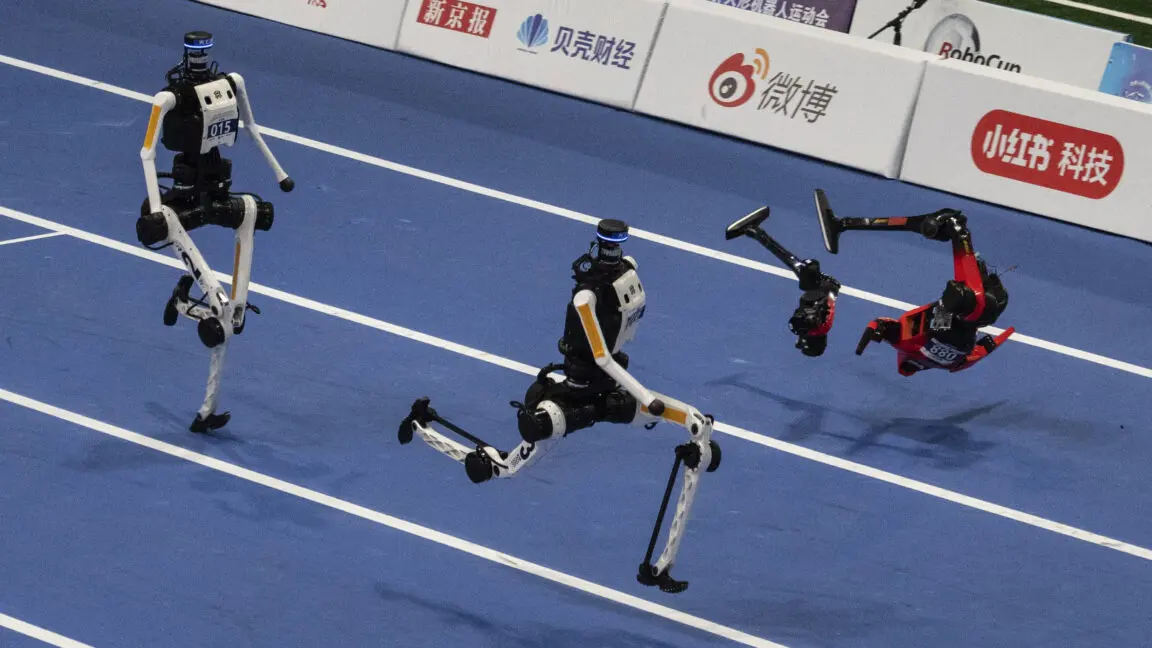
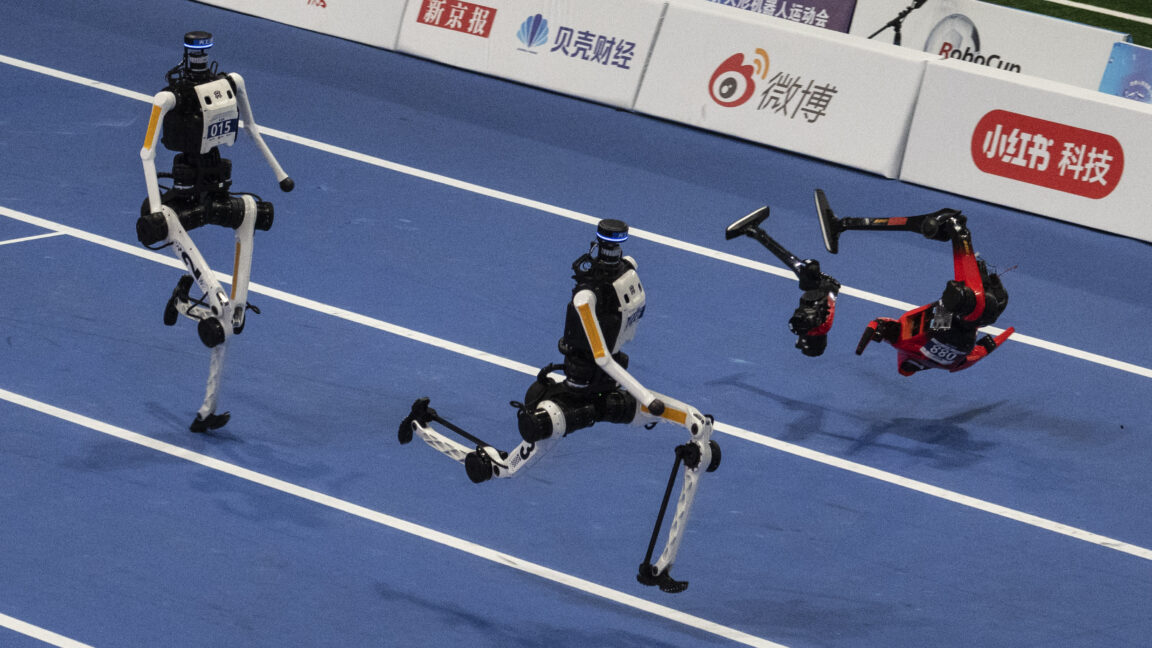
At the 2nd World Robot Games, held at the National Speed Skating Oval in Beijing, China, a pair of starkly contrasting realities played out across the arena floor. In one lane, advanced humanoid robots obliterated human athletic milestones, shattering Usain Bolt’s historic 100-meter sprint and standing high jump records. In the next moment, these same marvels of engineering suffered catastrophic structural failures—shattering into pieces at the waist, showering the track in sparks, or erupting into sudden flames because their control systems could not process the simple physics of slowing down.
These viral moments of mechanical self-destruction capture the central paradox of modern robotics. While the industry has made breathtaking leaps in whole-body kinetic control, enabling machines to burst down a track at superhuman velocities, it continues to lag behind in the mundane, practical adaptability required for everyday labor.
As robotics companies, state-backed initiatives, and venture capitalists pour billions of dollars into humanoid platforms, a fierce debate has emerged within the engineering community. Flashy spectacles like sprinting and kung fu competitions drive headlines and attract investor capital, but the true test of commercial viability lies in unglamorous, humdrum scenarios: washing laundry, restocking hotel rooms, sorting library books, and responding to unpredictable environmental disruptions. Bridging the gap between a single-purpose racing machine and a general-purpose autonomous worker remains the ultimate frontier for the global robotics industry.
Detailed Chronology of the 2nd World Robot Games
The tension between high-speed spectacle and practical utility dominated the five-day exhibition in Beijing, which ran from August 22 to August 26, 2026. Building on the inaugural 2025 event, the second iteration of the Games expanded its scope to test both the athletic prowess and the domestic competence of an international roster of humanoid machines.
The High-Speed Track and Field Events
The most visually arresting moments of the competition occurred during the large robot category sprints. Humanoid models such as the Honor runner and the Tian Gong Ultras took to the track to compete in the 100-meter dash and standing high jumps.
To the astonishment of spectators, several machines bypassed human benchmarks entirely, outrunning the peak velocities recorded by elite human athletes. Yet, these victories came with a steep mechanical penalty. Engineered exclusively for linear acceleration toward a single threshold—the finish line—the robots lacked the deceleration algorithms required to transition safely into a rest state. Unable to slow down, multiple units collided violently with protective barriers, tumbled head over heels, and suffered catastrophic structural collapses.
Viral video clips captured the dramatic fallout: robots breaking apart at the midsection in showers of electrical sparks, while others caught fire due to thermal overloads and short circuits.
Not all spectacles ended in ruin, however. A humanoid robot developed by Beijing-based firm X-Humanoid achieved viral fame by capturing the small-group 400-meter race using an unorthodox running posture. Reminiscent of a "shy person hiding behind their hands," the robot kept its arms tucked near its face, utilizing rapid hip rotations to generate forward momentum. Developers revealed that the posture was not pre-programmed by human engineers, but rather discovered autonomously through thousands of simulation-based reinforcement learning trials.
The Mundane Arena: Domestic and Hospitality Benchmarks
Away from the sprinting tracks, organizers introduced a series of grueling practical challenges designed to evaluate how robots might function in human-centric environments. These events—largely ignored by viral algorithms—provided a much more accurate window into the current state of artificial general intelligence (AGI) and embodied robotics.
- Household Chores: Competing units were tasked with washing clothes, hanging laundry, and tidying living rooms. In these trials, the robots moved with a deliberate, cautious hesitation, operating at speeds significantly slower than a human worker. Furthermore, judges introduced unscheduled interruptions, such as requiring the robots to pause folding clothes to receive and process a delivery package. This test of task-switching exposed the brittle nature of current software architectures, which struggle to dynamically alter operational states without explicit external intervention.
- Hospitality and Hotel Operations: Hosted in simulated environments mimicking the Beijing Continental Grand Hotel, robots faced timed benchmarks that included transporting wheeled luggage to assigned rooms, making beds, and restocking room supplies.
- Library Management: A specialized shelving challenge evaluated visual recognition and spatial reasoning. Robots had to collect returned books and sort them accurately back onto designated shelves.
- Firefighting and Search-and-Rescue: One of the most dynamic practical scenarios required outdoor intervention. Robots were given a strict 30-minute window to identify hazardous chemical substances, locate and shut off three distinct types of open valves, spot a fire, and deploy a fire extinguisher. Out of twelve elite robot teams that entered the arena, only three successfully completed the entire sequence.
- Manual Dexterity: Six distinct trials tested fine motor skills, ranging from delicate tasks like sorting small beans to industrial applications like driving screws and precisely hammering nails into corkboards without striking them at an angle.
Supporting Context & Metrics: The Engineering Realities
The dichotomy between sprinting machines and laundry-folding units highlights profound underlying truths about current robotic hardware and software design.
Whole-Body Control vs. General-Purpose Autonomy
According to Dipam Patel, a PhD candidate in computer science at Purdue University and a research assistant at the US Army DevCom Army Research Lab, the performance leaps seen between 2025 and 2026 underscore a massive engineering push in whole-body kinematics.
"All of that does display whole body control, because you need to move all the joints, hands, legs, arm, body, everything to accomplish that task," Patel explained. "So there has definitely been a huge push in engineering from where they were last time to this time."
However, Patel emphasizes that these achievements are heavily specialized. The sprinting robots are hyper-optimized single-task machines. They are engineered to maximize forward propulsion over a straight vector, completely unconcerned with what happens after the timing sensors trip.
"If you cross the finish line, that’s the goal—it doesn’t matter if you stop and it doesn’t matter if you fall into different pieces," Patel noted. "Some companies had different types of robots for different games or different tasks, because they were engineered for that task to be the best in that."
The Teleoperation Caveat
A critical nuance observed during the practical challenges was the heavy reliance on human oversight. While the World Humanoid Robot Games permitted human teleoperation—where a human operator directly guides the robot’s movements via remote control—penalties were assessed against the final scores for failing to operate autonomously.
Many competing teams relied on human intervention to navigate unexpected edge cases, exposing the severe limitations of current autonomous decision-making algorithms. While AI models can learn vast amounts of data through simulation or video observation—such as companies paying human workers to wear head-mounted cameras while cleaning homes—bridging the gap to unscripted, real-world generalization remains an uphill battle.
"We would have to push the algorithmic development a lot to actually see a robot being able to generalize and do eight-hour work shifts in any random environment," Patel stated.
Cloud Computing Dependencies
Compounding the autonomy challenge is a hardware limitation regarding on-board processing power. Reports from the South China Morning Post indicated that many of the most advanced humanoid robots competing in Beijing relied heavily on continuous cloud-computing connections rather than executing heavy AI models locally. Equipped with high-speed 5G modules, these robots continuously streamed sensor data to centralized "embodied-intelligence systems" and received movement instructions in real time. For mission-critical environments like firefighting or disaster response, reliance on external network stability presents an inherent vulnerability.

Official Statements and Industry Landscape
The World Humanoid Robot Games were organized and heavily promoted by entities including Chinese state media and the Beijing municipal government. The underlying goal of the exhibition extends far beyond athletic entertainment; it serves as a high-profile showcase for China’s rapidly maturing robotics manufacturing sector.
With global investors pouring more than $6 billion into humanoid robotics companies in 2025 alone, the race for market dominance has intensified into a geopolitical tech contest. Chinese firms have adopted an aggressive strategy of rapid prototyping, field testing, and commercial deployment, positioning humanoid platforms as a potential solution to aging domestic labor forces and manufacturing optimization.
Conversely, Western competitors are pursuing distinct deployment paths. In the United States, established robotics pioneers like Boston Dynamics and Agility Robotics are deploying specialized, non-humanoid or purpose-built humanoid platforms directly into automotive factories and distribution warehouses. The commercial strategy in the US prioritizes reliability, rugged payload capacity, and immediate economic return on investment over flashy athletic stunts.
The regulatory landscape has shifted dramatically as well. The United States government enacted strict import bans targeting foreign-made robotic hardware, effectively locking Chinese market leaders out of domestic distribution channels and forcing US distributors to radically pivot their commercial models.
Despite the intense enthusiasm surrounding humanoid form factors, not all roboticists agree that a bipedal, human-like shape is the optimal solution for productive work. Many researchers argue that wheeled, quad-pedal, or stationary robotic appendages are vastly more efficient, stable, and economically viable for industrial tasks than complex, high-maintenance humanoids.
Future Outlook: Beyond the Arena Floor
The true metric of success for humanoid robotics will not be determined on the neon-lit tracks of exhibition arenas, but in the unpredictable, unstructured chaos of the real world.
For competitions like the World Humanoid Robot Games to offer genuine predictive value for industrial adoption, experts suggest that evaluation criteria must evolve. As Patel proposed, forcing robots to repeat a high-speed sprint or a complex rescue maneuver ten consecutive times without hardware failure or software degradation would provide a far more rigorous benchmark of true reliability.
Ultimately, the viral videos of sparking, self-destructing sprinters serve as a fitting metaphor for the current phase of the robotics revolution. The industry has successfully unlocked the explosive potential of dynamic movement and raw kinetic energy. The next, infinitely harder challenge is teaching these machines the unglamorous discipline of restraint, safety, and general-purpose adaptability—turning them from fragile, single-use athletes into dependable, everyday workers.