









Executive Overview
For organizations relying on open-source automation servers, scale is a double-edged sword. While Jenkins remains a foundational pillar for continuous integration and continuous delivery (CI/CD) pipelines across the global enterprise ecosystem, its legendary flexibility carries a heavy operational tax. When an organization’s infrastructure expands to encompass more than 150 distinct Jenkins instances scattered haphazardly across on-premises data centers, Amazon Web Services (AWS), and Microsoft Azure, the classic administration playbook breaks down completely.
Every master drifts. Plugins fall out of sync, storage capacities quietly approach critical thresholds, one development team’s experimental "quick fix" mutates into another department’s mission-critical outage, and enterprise architects are left without a single, unified pane of glass to observe what is actually executing across the corporate ecosystem. Manual administration becomes an untenable bottleneck.
To confront this crisis of scale, an enterprise platform engineering team embarked on a rigorous, 20-month initiative divided into three distinct phases. Their mission: design, build, and deploy a centralized UI and automation control plane capable of orchestrating upgrades, backups, rollbacks, monitoring, and access management across the entire fleet of Jenkins masters. Crucially, this system was architected to liberate application teams from the burden of manual Jenkins administration, replacing ad-hoc firefighting with a secure, self-service operational model.
Detailed Chronology: The 20-Month Path to Fleet-Wide Control
The journey from fragmented chaos to unified control was not achieved overnight. It required a methodical, multi-phased engineering effort spanning nearly two years, characterized by meticulous stakeholder interviews, rigorous architectural design, and extensive simulation testing before any code touched production environments.

Phase 1: Discovery, Wireframing, and Architecture (Months 1–6)
The project began with an exhaustive audit of the existing CI/CD footprint. Platform engineers conducted deep-dive interviews with various development pods, uncovering a litany of chronic pain points:
- Plugin Inconsistencies: Ad-hoc upgrades performed by individual teams left masters running wildly divergent plugin versions, frequently breaking pipelines upon execution.
- Fragmented Backup Strategies: While some teams rigorously backed up their Jenkins homes, others operated without disaster recovery safety nets, risking catastrophic data loss.
- Blind Spots in Monitoring: There was no centralized alerting mechanism for infrastructure metrics, meaning instances routinely ran out of disk space or memory without warning.
- Compute Waste: Inefficient job configurations—particularly non-lightweight checkouts—quietly consumed exorbitant amounts of compute resources, inflating cloud bills unnecessarily.
Recognizing that a collection of disparate shell scripts would only compound the maintenance burden, the team pivoted toward designing a true control plane. They established an Agile delivery framework characterized by bi-weekly sprints, daily stand-ups, and comprehensive Scrum ceremonies. Initial architectural blueprints were translated into interactive Figma wireframes to validate user experience workflows before a single line of backend code was written.
Phase 2: Core Engineering and Idempotent Playbooks (Months 7–14)
The second phase focused on constructing the dual-layered architecture: a responsive user interface communicating with a robust, multi-tier backend, underpinned by bulletproof automation scripts.
The frontend was engineered using React and Redux, integrated with Material-UI components to deliver a clean, intuitive dashboard. This interface communicated with a Python backend split across Flask and FastAPI, cleverly separating synchronous administrative actions from real-time data synchronization.
Beneath the application layer lay the operational workhorses:
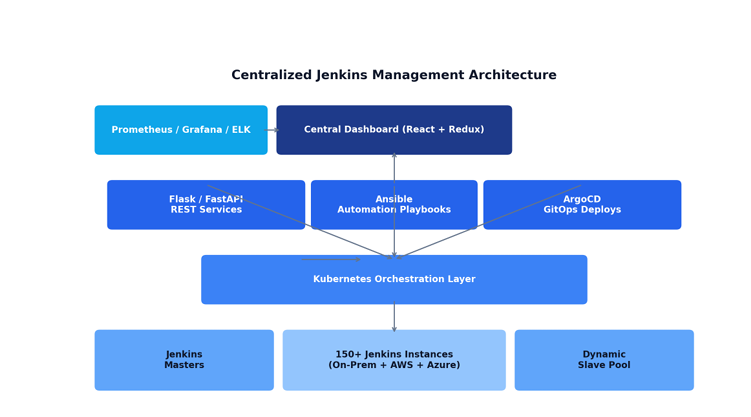
- Ansible Playbooks: Designed with strict idempotency at their core. Because these playbooks could be safely re-run without risking side effects or inconsistent system states, rollbacks transformed from high-stress manual scrambles into predictable, push-button procedures.
- Kubernetes and Helm: Leveraged to dynamically provision Jenkins agents on-demand, aligning compute capacity precisely with real-time job demand.
- ArgoCD: Deployed to drive GitOps-style rollouts consistently across hybrid cloud environments (AWS and Azure) and on-premises infrastructure.
- Prometheus, Grafana, and ELK Stack: Integrated to handle metrics, log aggregation, and real-time alerting, ensuring the dashboard reflected live fleet health rather than a static inventory.
Phase 3: Integration Testing, Pilot Rollout, and Self-Service (Months 15–20)
Before transitioning to production, the engineering team subjected the control plane to rigorous integration testing that simulated the entire 150+ instance fleet within Docker and Kubernetes environments. The test suite combined Jest for unit testing, Cypress for comprehensive end-to-end UI validation, and Locust for high-concurrency load testing under simulated fleet-wide operations.
The final months were dedicated to stabilizing the "seams" between disparate technologies. Maintaining real-time synchronization of fleet state across the dashboard without introducing network lag required multiple iterations of polling and event-driven models. Furthermore, writing custom adapters was necessary to bridge the gap between on-premises hardware, AWS, and Azure, ensuring a uniform interface for the control plane. Once these hurdles were cleared, the self-service portal was unveiled to application teams, officially signaling the transition from centralized policing to decentralized empowerment.
Supporting Context & Metrics: The Anatomy of the Control Plane
The centralized control plane fundamentally altered how the organization interacted with its CI/CD tooling. By shifting the paradigm from manual intervention to automated guardrails, the platform yielded immediate, quantifiable dividends.
Core Capabilities of the New Platform
- One-Click Upgrades and Rollbacks: Executed seamlessly as idempotent Ansible plays targeting any subset of the 150+ instances, drastically reducing maintenance windows.
- Differential Backups: Automated via
rsyncdirectly to S3-compatible object storage, scheduled centrally rather than relying on disparate, per-instance cron jobs. - Dynamic Agent Provisioning: Leveraging Kubernetes Helm charts to scale worker nodes dynamically, eliminating idle resource costs.
- Comprehensive Resource Reporting: Surfaces critical insights regarding failed jobs, chronically unused pipelines, non-lightweight checkouts, and high-resource resource hogs, empowering development teams to optimize their own workflows.
- Enterprise-Grade Governance: Centralized org-wide access management and immutable audit logging that effortlessly satisfies stringent SOC 2 and GDPR compliance requirements.
- Self-Service Portal: Enables application teams to perform routine administrative tasks autonomously, eliminating the friction of filing platform support tickets.
Quantifiable Impact
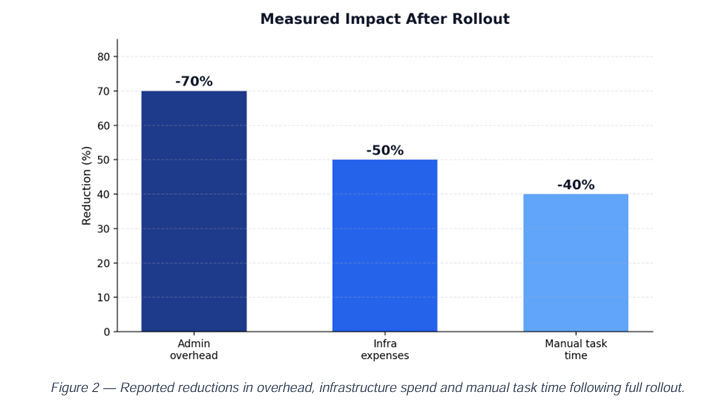
Following full enterprise-wide deployment, internal metrics highlighted dramatic operational improvements:
- Administrative Overhead: Slashed significantly, freeing platform engineers from routine firefighting.
- Infrastructure Expenditure: Achieved a meaningful reduction in cloud and on-premises infrastructure spend through intelligent resource allocation, elimination of idle capacity, and mitigation of unexpected downtime.
- Developer Productivity: Logged a massive reduction in the hours spent by software engineers on manual Jenkins upkeep, redirecting those valuable hours back toward core product development and feature delivery.
Official Statements & Engineering Insights
Reflecting on the philosophical shift behind the project, lead architects emphasized the importance of guardrails over micromanagement:
"This kind of fleet-wide control plane is not a novel idea on its own—there is a long history of tools designed to orchestrate multiple Jenkins instances," noted a lead platform architect during the rollout review. "What made the difference here was combining self-service automation with genuinely actionable job reporting. Our job shifted from firefighting individual instances to setting secure, reliable guardrails that the rest of the organization could operate within safely."
The emphasis on idempotency was repeatedly cited as the secret weapon of the architecture. By ensuring that every configuration state could be applied repeatedly with identical, predictable outcomes, the engineering team removed the fear traditionally associated with large-scale infrastructure modifications.
Future Outlook: Beyond Jenkins
While taming the sprawling 150+ instance Jenkins fleet marked a monumental milestone for the organization, the platform engineering team views this control plane as merely the foundation for a broader operational evolution.
Looking ahead, the roadmap features two primary strategic thrusts:
- Predictive Resource Scaling: Implementing machine learning-driven analytics to anticipate peak CI/CD demand windows, automatically pre-provisioning agent capacity before pipelines queue up.
- Multi-Tool CI/CD Extension: Expanding the centralized self-service architectural model to encompass alternative CI/CD tooling as the enterprise’s pipeline technology stack continues to diversify across cloud-native ecosystems.
By treating internal infrastructure as a product rather than an afterthought, this enterprise has successfully transformed its greatest technical debt into a streamlined, automated competitive advantage.