











Executive Overview
As artificial intelligence cements its role as the backbone of modern software development, a new vernacular has rapidly cycled through engineering departments. Among the most recent and paradoxical terms to enter the developer lexicon is “tokenmaxxing.” Emerging as a tongue-in-cheek descriptor before being co-opted into corporate optimization strategies, tokenmaxxing left the developer ecosystem almost as quickly as it arrived. Yet, its legacy exposes a critical structural vulnerability in how modern organizations measure engineering productivity in the age of generative AI.
In practice, the term has been deployed in two diametrically opposed ways:
- Maximizing total token consumption as a crude proxy for AI adoption and developer effort.
- Optimizing output per token as a definitive measure of efficiency and skill.
Conflating these two concepts has triggered widespread strategic miscalculations. Organizations are reaching for the wrong measurement frameworks at the wrong time, mistaking raw computational consumption for genuine productivity.
Token usage is fundamentally a derivative metric—a function of query volume, prompt complexity, and context windows (the sheer quantity of data loaded into and extracted from a model during each exchange). While tracking token consumption can indicate whether a developer is actively engaging with AI tooling in the nascent stages of digital transformation, it fails entirely to measure the quality or business value of that output. Put simply: consuming a massive volume of AI compute is not the equivalent of wielding artificial intelligence effectively.
This investigation explores the pitfalls of treating supplier billing units as internal Key Performance Indicators (KPIs), analyzes the parallels between lines-of-code metrics and tokenmaxxing, highlights the shift toward agentic workflows, and outlines a maturity model based on cost-per-outcome and security-centric governance.
Detailed Chronology: The Lifecycle of a Tech Buzzword
To understand how enterprises fell into the tokenmaxxing trap, it is necessary to retrace the rapid evolution of generative AI integration over the past several years.
Phase 1: The Adoption Boom and the Visibility Vacuum
When large language models (LLMs) first broke into mainstream software engineering, enterprise leadership faced an immediate anxiety: Are our developers actually using these expensive tools?
Software procurement teams invested heavily in enterprise seats for AI coding assistants. Suddenly, dashboards lit up with unprecedented data streams. Chief Technology Officers (CTOs) and Engineering VPs, starved for telemetry on how AI was impacting daily workflows, seized upon the most readily available metric provided by cloud and AI vendors: total tokens consumed.
In this initial phase, high token counts were interpreted as a positive sign of high utilization and aggressive transformation. If a developer’s token graph looked like a hockey stick, leadership assumed productivity was soaring.
Phase 2: The Co-Option of ‘Tokenmaxxing’
As developers began comparing notes on forums, Slack channels, and tech enclaves, the term "tokenmaxxing" surfaced. Initially used with a degree of irony, it parodied the hyper-optimized lifestyle trends popular in other online subcultures. Developers joked about maximizing their personal or team token allowances to squeeze every ounce of reasoning power out of frontier models.
However, middle management and organizational metrics-trackers often missed the irony. Seeking quantifiable ways to justify software tooling budgets, organizations began formalizing token consumption targets. What started as developer slang quickly hardened into corporate key performance indicators. Engineers were subtly—and sometimes overtly—incentivized to keep their AI assistants running, spinning up long, conversational prompt threads and feeding massive codebases into context windows whether it was necessary or not.
Phase 3: The Productivity Illusion and the Developer Backlash
By late 2024 and into 2025, the cracks in the tokenmaxxing facade became impossible to ignore. Organizations realized that inflating token volume was actively breeding bad habits. Developers running unoptimized, chatty workflows were racking up staggering API and enterprise licensing bills while delivering code that was bloated, poorly scoped, and difficult to maintain.
Simultaneously, enterprise token budgets collided with reality. Organizations placed artificial caps and quotas on token usage to control surging operational expenditures. The result was a predictable behavioral loop: engineers, feeling artificially constrained despite clear productivity gains, began migrating to unmonitored personal accounts, shadow-IT tools, and free-tier alternatives to maintain their velocity.
The tokenmaxxing bubble had burst, leaving engineering leaders to confront a sobering truth: they had built incentive structures around a vanity metric that rewarded verbosity over value.
Supporting Context & Metrics: Activity vs. Productivity
The fundamental flaw of the tokenmaxxing framework stems from an error the software industry should have learned to avoid decades ago: confusing activity with productivity.
The Ghost of "Lines of Code" (LoC)
For decades, dysfunctional engineering organizations evaluated developers by their "Lines of Code" (LoC). The perverse incentives of this metric are legendary. When developers are rewarded for producing more code, the natural result is verbose, redundant, and unnecessarily complex engineering solutions. Clean, efficient, modular code that solves a problem in ten lines scores worse than a sprawling, messy function spanning two hundred lines. LoC rewarded busyness over brilliance.
Token usage as a productivity metric suffers from this exact pathology. Consider a practical scenario:
- Developer A approaches a complex debugging task with poorly scoped prompts. They allow context to drift across sprawling, unstructured conversations, forcing the AI model to repeatedly reconstruct background information, ingest irrelevant files, and generate multiple false starts. Their token consumption skyrockets.
- Developer B tackles the identical task using a well-configured, concise workflow. They provide targeted context, write precise prompts, and achieve the desired outcome with minimal back-and-forth.
Under a naive tokenmaxxing framework, Developer A looks like a high performer because they consumed ten times as many tokens. In reality, they were simply generating computational noise. By building incentive structures around token volume, organizations risk training their engineering teams to be inefficient.
The Shift to AI-Directed Development Environments
This dynamic is further exacerbated by the evolution of modern development architectures. The industry is rapidly moving beyond simple AI-assisted coding (where a bot autocompletes lines in an IDE) toward AI-directed development environments.
In these advanced environments, human engineers act more like orchestrators or technical directors, coordinating specialized autonomous agents responsible for distinct phases of the software lifecycle:
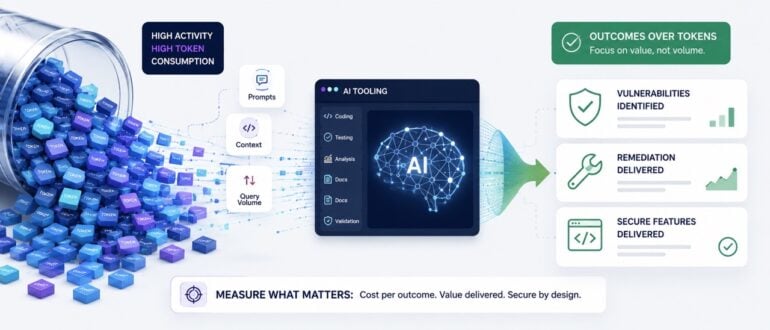
- Coding and implementation
- Automated testing and test-case generation
- Static analysis and vulnerability scanning
- Technical documentation and validation
In an agentic ecosystem, measuring token consumption becomes as detached from business value as measuring CPU utilization to evaluate software quality. A background agent running thousands of reasoning tokens to securely refactor a cryptographic library is vastly different from a developer burning tokens on repetitive UI styling questions. What matters is not how many tokens were burned, but whether the resulting system delivers secure, validated, and maintainable outcomes efficiently.
Official Perspectives and Analytical Frameworks
As software engineering leadership matures past the initial hype cycle of generative AI, industry experts and security practitioners are redefining how AI tooling value must be assessed.
Security teams, in particular, face high stakes. In cybersecurity, AI models are routinely deployed to unearth vulnerabilities, assist with threat modeling, and accelerate incident remediation. For these practitioners, the debate cannot be reduced to a binary choice between "maximize tokens" or "minimize tokens." Instead, the focus must shift entirely toward cost-per-outcome.
The Utility of Independent Benchmarks: BountyBench
Token-based pricing is a rational commercial model for AI providers selling raw compute. The systemic failure occurs on the buyer side—when organizations lazily import a vendor’s billing unit directly into their internal productivity scorecards.
It is true that more capable models often consume more tokens and unearth deeper insights. Extended reasoning, complex agentic trajectories, and multi-attempt scaffolding naturally cost more tokens. When applied to difficult, high-stakes engineering or security problems, this additional compute meaningfully improves outcomes.
However, that relationship is not universal. The exact same token spend across two different configurations, model families, or prompting strategies can yield wildly disparate results. Inefficient scaffolding, poor context management, and sloppy prompting drive up token consumption without providing proportional gains in output quality.
To cut through the noise, engineering leaders are increasingly turning to independent evaluation frameworks like BountyBench. By benchmarking AI models and configurations against real-world bug bounty programs, BountyBench measures the cost-per-finding. This gives security teams a rigorous, empirical mechanism to evaluate actual outcomes relative to computational spend, rather than treating either metric in isolation.
For security leadership, this reframes the entire productivity question: The goal is not to maximize AI usage; it is to minimize the cost and time required to achieve a verified security finding or a secure release.
Future Outlook: Re-Engineering Metrics for the Post-Tokenmaxxing Era
How should modern technology organizations measure the true impact of their AI investments moving forward? The guiding question must permanently shift from "How much AI did we use?" to "What did we actually deliver, and at what economic and operational cost?"
Industry leaders should pivot toward three core evaluation metrics:
1. Remediation Value Per Token Spent
Organizations must measure whether AI usage is materially reducing technical and security debt, accelerating patching cycles, or improving the quality of vulnerability remediation. High token consumption that fails to correlate with a measurable reduction in security risk is merely expensive activity, not efficiency.
2. Vulnerabilities Surfaced Per Query (Signal-to-Noise Ratio)
Engineering teams should evaluate how effectively their AI-assisted workflows uncover meaningful, actionable security findings. The objective is not simply generating higher volumes of text or code, but systematically increasing the signal quality and depth of discovery with every interaction.
3. Secure Features Delivered to Production
Success must be measured by whether AI accelerates the delivery of production-ready functionality that rigorously meets organizational security, compliance, and quality standards. The goal is not churning out more lines of code, but compressing the time and effort required to produce secure, verified software outcomes.
Governance, Token Budgets, and the Constrained Engineer
From a governance standpoint, one of the most dangerous missteps an enterprise can make is responding to tokenmaxxing disillusionment by slamming the brakes on AI budgets entirely.
When organizational token quotas are set too conservatively, developers face an impossible constraint: slow down, or find another way. Predictably, talented engineers will bypass corporate guardrails, reaching for personal accounts, unvetted third-party tools, or free-tier cloud models simply to maintain their velocity.
This behavior is not born of malice; it is a rational response from professionals trying to ship products under artificial constraints. However, it creates a massive governance vacuum. When development occurs outside enterprise-controlled environments, organizations lose all visibility, auditability, and assurance that outputs meet internal security and compliance standards.
Forward-thinking organizations are taking a different path. Rather than rationing tokens based on blunt administrative targets, mature enterprises provide security and engineering teams with intentional, well-audited token budgets explicitly calibrated for deep vulnerability assessments and complex agentic workflows. They measure the returns on that investment, establishing a rigorous feedback loop.
Conclusion
Token usage was never designed to bear the heavy weight of a primary productivity KPI. As enterprise AI programs mature, the corporate conversation is shifting decisively from "Are we using it?" to "Is it actually working?"
When viewed through this lens, tokenmaxxing stands revealed as what it always was: a temporary vanity metric dressed up as an engineering discipline. Organizations that abandon these superficial activity metrics today—and replace them with outcome-aligned measurement frameworks—will secure a sustainable competitive advantage, building not only faster software, but a demonstrably stronger and more resilient security posture.